Your new upload sat at 300 views after an hour. You are thinking about deleting it and trying again. Don't.
How the YouTube algorithm works is not what most creators picture. There is no single rulebook that pushes your video out to viewers. There is a recommendation system that pulls, for every person who opens the app, the videos most likely to suit that person at that moment. And inside that system, long-form videos, Shorts and podcasts are scored on different signals. A tactic that helps one format can quietly hurt another.
This guide covers how the system is built, what changed in 2025 and 2026, and which numbers to check in your own channel, and when. It is about organic growth. If you are wondering whether YouTube even counts as a social platform for your marketing mix, we covered that question separately.
Two Stages Decide What Anyone Sees
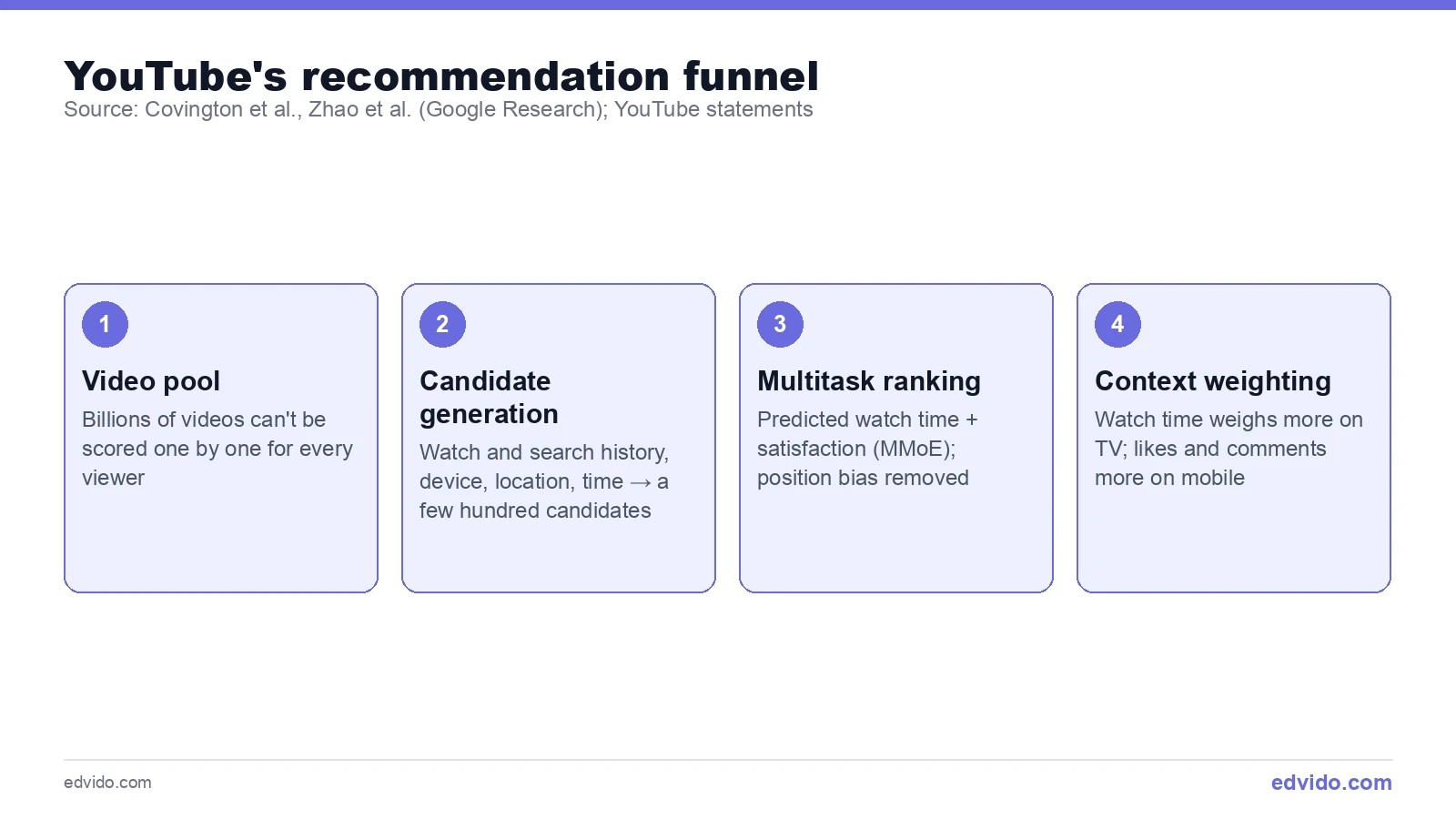
According to papers published by Google researchers (Covington et al., Zhao et al.), YouTube's recommender runs as a two-stage deep learning funnel. Scoring billions of videos for every single viewer is not feasible, so the pool is narrowed first and ranked second.
Candidate generation. The first network combines a viewer's watch and search history with device, location and time of day, and shrinks billions of videos down to a few hundred candidates. What matters here is how close a video sits to that viewer, and co-watching patterns define that closeness.
Multitask ranking. The few hundred candidates then go into a richer network that does not just predict a click. It predicts expected watch time and whether the viewer will be satisfied. YouTube uses an architecture called Multi-gate Mixture of Experts (MMoE): engagement goals such as clicks and watch time and satisfaction goals such as likes, shares and survey scores are handled by separate expert networks and then balanced.
A sensational video can get clicked and watched in the short term while leaving people disappointed. In the live experiments Google published, an 8-expert MMoE model improved engagement by +0.45% and satisfaction metrics by +3.07% over the older baseline. The system is deliberately tuned toward satisfaction, not raw clicks.
There is also position bias. People click whatever sits at the top of a list, simply because it is at the top. YouTube models that effect with a small separate network and removes it from the score. So "it showed up first and got clicked" does not mean your video was good, and the system knows it.
Three Things That Changed in 2025-2026
According to Todd Beaupré, YouTube's senior director of growth and discovery, the recommender moved from small language models to large language models and multimodal (image plus audio) analysis. The old system would recommend every car channel to someone who watched one car video. The new one reads on-screen text, speech, tone and editing pace in the opening seconds. It can tell whether a car review is comedic or serious, and whether a tutorial is for beginners or experts.
Second, there is no fixed signal weighting anymore. The algorithm shifts weights by device and time of day. On smart TVs and desktop, total watch time and video quality count for more. On mobile, likes, comments and large on-screen text count for more, because tapping a phone screen is much easier than using a remote.
Third, dubbing. Audio tracks in different languages are now treated as independent performance channels. A weak Spanish track does not cut a video's impressions with English-speaking viewers.
Five Surfaces, Five Different Logics
What people call "the YouTube algorithm" is really five recommendation surfaces, each weighting signals differently depending on where the viewer is.
| Surface | What it looks at | What it means in practice |
|---|---|---|
| Home | Watch history, subscriptions, device, time | Small channels can rise fast here if the people they are shown to keep watching |
| Suggested / Up next | The video being watched, co-watching | Videos that extend the session or offer the logical next step win |
| Search | Query relevance, semantic intent | A small channel that answers the question more clearly can outrank a big one |
| Subscriptions | The channel's upload activity | Subscriber click-through is under 10% on almost every channel, and that is normal |
| Shorts feed | Viewed vs. swiped away | Runs independently of long-form history; there is no click |
Knowing this makes diagnosis easier. If a video does well in search and poorly on Home, packaging may not be the problem; the topic may simply serve a narrow audience.
Long-Form: Keep the Viewer on the Platform
On long-form, the viewer makes a deliberate choice to click. That is why the algorithm checks the match between what the title and thumbnail promise and what the video delivers most strictly here. Raw watch time is no longer decisive on its own. Three groups of signals are read together.
Satisfaction. A video watched to the end is not always a video people liked. Someone may have stayed hoping for the promised payoff and left disappointed. YouTube catches this with surveys shown to random viewers after a video, asking things like "Was this video useful?". A video with low satisfaction can fall behind competitors even with strong retention.
Session contribution. According to vidIQ's 2026 analysis, the standout signal is how much a video adds to the viewer's total YouTube session. Watching and then closing the app is a bad sign. Watching two or three more videos through end screens or a playlist is a good one.
Relevance. The first 40 characters of the title, the description, chapters and captions still matter. But the model now also reads speech and on-screen text in the first five seconds to decide which audience to match the video with.
A new video goes through four test layers
According to analyses by vidIQ and OutlierKit, a new long-form upload is not distributed at random:
- Micro-audience. Within minutes it is shown to some subscribers and a lookalike group of 10-100 people who closely match the channel's audience.
- Wider niche. If clicks, retention and satisfaction are strong in the first 24-48 hours, it opens to larger audiences in the same niche over 7-14 days.
- Adjacent topics. If performance holds, it is recommended to people interested in related subjects outside the niche.
- Broad distribution. Videos that clear every threshold get wide exposure on Home.
In thumbnail tests, chase watch time share, not CTR
YouTube Studio's Test & Compare now runs three title or thumbnail variants at once. It picks the winner by watch time share, not click-through rate, and deliberately hides per-variant CTR. In OutlierKit's example, a sensational thumbnail with 9.0% CTR that held viewers for an average of 3:48 lost to a plainer one with 6.8% CTR that held them for 6:17.
- Picking the thumbnail that gets the most clicks
- Spending the first 30 seconds on a channel intro
- Saying "now let's move to step two" and leaving a gap
- Picking the thumbnail that attracts viewers who stay
- Delivering the promise in the first five seconds
- Opening the next question before the current topic ends
That last point is a loss most channels miss. Content strategists call it segmentation loss: a clean closing line tells the viewer's brain the section is over and they can leave. Retention Rabbit's May 2025 benchmark found that videos keeping more than 65% of viewers past the first minute earn 58% higher average view duration over the rest of the video.
Myths YouTube Has Publicly Debunked
At VidCon and in Creator Insider conversations in 2026, Todd Beaupré addressed several beliefs that circulate among creators. These are the questions we hear most from teams working with agencies.
You can also watch a short video summary of this topic:
Subscribe to our YouTube channel| Myth | What YouTube says |
|---|---|
| "Videos are tested on subscribers first; if they don't click, the video dies." | New videos reach people who have never watched the channel, even in the first hour. Subscribers, non-subscribers and first-time viewers are tracked separately. |
| "Subscriber CTR under 10% means failure." | Nearly every channel's CTR in the Subscriptions feed is 10% or lower. That is normal. |
| "A slow first hour seals the video's fate." | The first hour is the smallest slice of data. Viewers see a thumbnail several times before clicking; internal experiments show clicks on the 3rd, 6th, even 8th impression. A long video uploaded in the morning can pick up in the evening when people move to the TV. |
| "Taking a break punishes the channel." | Internal research across millions of channels found no correlation between upload gaps and return viewership. |
| "A brand-new channel can't be recommended." | Channels with no history get a "first look" test: the video is shown to a small group interested in the topic, and distribution grows if they watch. |
According to Shorts product lead Todd Sherman, doing so risks being flagged as spam by automated systems. The first-hour number is not enough data to act on.
Smaller channels also have Hype. On channels with 500 to 500,000 subscribers in the YouTube Partner Program, viewers can give three free Hypes a week to videos published in the last seven days. Fewer subscribers means more points per Hype, and videos that collect enough points enter a country leaderboard and get placed on the Home feeds of people who don't know the channel.
Shorts: The Swipe Decides Everything
Shorts have no thumbnail click. Viewers run into a video while moving through the feed, so the algorithm uses an explore-exploit model, and subscriber count has almost no effect on distribution.
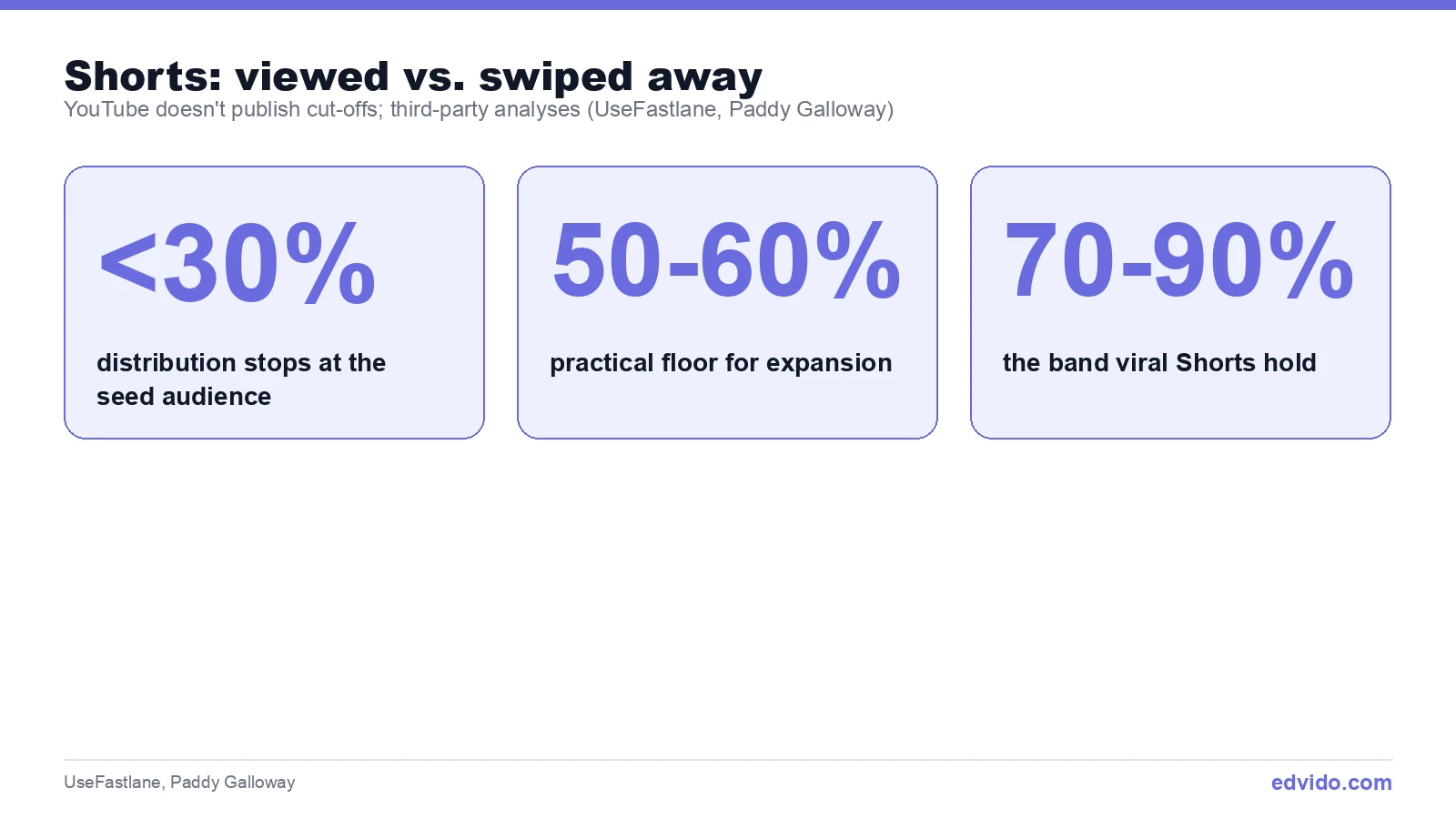
A Short is first shown to a seed audience of a few hundred, sometimes 1,000-2,000 people. The familiar "my Short hit 1,200 views and then flatlined" is usually not a penalty; it is that seed test ending. If the seed audience swipes away fast, distribution stops there. If thresholds are cleared, the video grows wave by wave, and the best ones spread to Home, search and related long-form watch pages.
The first gate is the viewed vs. swiped away ratio shown in Studio as "How many chose to view". YouTube doesn't publish exact cut-offs, but third-party analyses (Paddy Galloway, UseFastlane) show this pattern in practice:
Length matters too. In Inflow Network's study of 5,400 Shorts, 50-60 second videos averaged 1.7 million views against 77,000 for 0-10 second ones. Part of that is survivor effect: people who will swipe leave in the first seconds, and those past the 30-second mark tend to finish. But stretching a 12-second idea to 45 seconds dilutes the average. The three-minute limit rewards depth only when there are no dead spots.
- Views split in two: the public counter counts every play; monetization and YPP eligibility use "engaged views".
- Engineered loops stopped working: the system can tell a natural rewatch from a sentence cut mid-way to force a loop.
- Other platforms' watermarks are penalized: TikTok or Reels logos limit reach from the start.
- Shorts history is separate: Home no longer looks at which Shorts someone watched, so a weak Short won't drag your long-form down.
Podcasts: A Studio Setting, Not a Format
YouTube is now the biggest place people discover podcasts. But two people talking into microphones doesn't make a video a podcast. Episodes need to sit in a playlist marked as a Podcast in YouTube Studio. Once that is done, the channel gets a Podcasts tab, the show becomes eligible for the podcast shelves on Home and smart TV, and it is distributed to YouTube Music automatically. Naming the playlist with a searchable show name instead of "Episodes" is a search signal in itself. If you are still choosing that name, our podcast naming guide walks through it.
For podcasts, the algorithm leans on total watch time more than clicks. The reason is the living room: podcast watch time on smart TVs grew from 400 million hours a month in 2024 to 700 million hours a month in 2026. Around 40% of new podcast discoveries also come from in-platform search. YouTube transcribes episodes and indexes them semantically, so it can surface the exact minute in a two-hour conversation where the searched topic comes up.
According to industry research shared by Castos, podcast uploads that play audio over a fixed cover image lose 90-95% of viewers in the first 90 seconds. When NPR's Life Kit added studio camera footage, views per episode rose 16-fold. If you can't film, YouTube's "Generate video from audio" tool, launched in 2026, noticeably improves retention over a static cover.
One more caution: average completion for video podcasts on YouTube is around 26-27%, against 83% in audio apps. On YouTube, podcasts mostly live at the top of the funnel. The most effective way to feed that funnel is posting a sharp 45-second clip as a Short and linking it to the full episode with the Related Video feature.
Need a team to run strategy, editing and analytics for your channel? Compare social media and YouTube agencies on Edvido. Send your brief, get matched right away, completely free.
Compare AgenciesWhat to Check in Your Own Channel, and When
Knowing how the algorithm works only helps if you read Studio data in the right time window. This calendar is the part we see skipped most often.
- Packaging check at hour 48. Ignore the first hour. Go to Analytics → Reach → Traffic source types → Browse features → Subscriptions. Subscribers are a stable control group; low CTR or watch time there points to the title, thumbnail or first 30 seconds.
- Expansion check on day 7 and day 28. On day 7, see whether Browse and Suggested traffic is still growing daily. On day 28, compare the video with past videos of similar length and topic, not your all-time best.
- Split the retention graph. Separate new and returning viewers. If new viewers drop fast in the first 30 seconds, your opening doesn't land with a cold audience. Look at every dip of 4% or more.
- Wait 48 hours on Shorts. Check "Shown in feed" first, then the viewed vs. swiped ratio. If the ratio is below your last ten Shorts, rebuild the first two seconds.
- Set up podcasts properly. Put episodes in a Podcast playlist, avoid static covers, and link 30-60 second Shorts clips to each full episode.
If you don't have the people in-house, outside help makes sense. For filming and editing, look at video production agencies. And if you want to know how YouTube content earns your brand visibility in AI search answers, our piece on YouTube content for GEO picks up where this one ends.
Collecting quotes for video, editing or channel management? Send your brief, get matched right away, completely free.
Get Free QuotesWe also talked about this topic in our podcast episode:
Subscribe to our YouTube channelFrequently Asked Questions
How does the YouTube algorithm work?
In two stages. Billions of videos are first narrowed to a few hundred candidates based on a viewer's history, device and time of day. Those candidates are then ranked by predicted watch time and viewer satisfaction. Long-form videos, Shorts and podcasts are scored on different signals within that system.
Does the first hour matter on YouTube?
According to YouTube, no. The first hour is the smallest slice of data. Viewers see a thumbnail several times before clicking, and long videos can pick up in the evening on smart TVs. Wait at least 48 hours before judging.
Why did my Short suddenly stop getting views?
Usually it isn't a penalty; it's the end of the seed audience test. The Short is shown to a first group, and if most of them swipe away in the opening seconds, distribution doesn't expand. Check the viewed vs. swiped ratio in Studio and rework the opening.
Will posting Shorts hurt my long-form videos?
Since late 2025, Shorts and long-form watch histories are kept separate, so a weak Short won't drag your long-form down. If both formats serve the same audience, publishing them on one channel can speed up growth.
How do podcasts get recommended on YouTube?
Mark episodes as a Podcast playlist in Studio, give the show a searchable name, use camera footage or animated visuals instead of a static cover, and link Shorts clips back to full episodes. For podcasts, total watch time and smart TV viewing matter more than clicks.
Does turning off comments or taking a break reduce reach?
According to YouTube's internal research, no. No correlation was found between upload gaps and return viewership, and missing signals aren't treated as negative.