To verify agency reviews, check four things together: how many reviews sit behind the rating and how recent they are, how the platform confirms that a reviewer was a real client, whether paying the platform changes the order you see, and whether the agency's case studies and references hold up when you test them yourself.
Each check alone is weak. Together they're hard to fake.
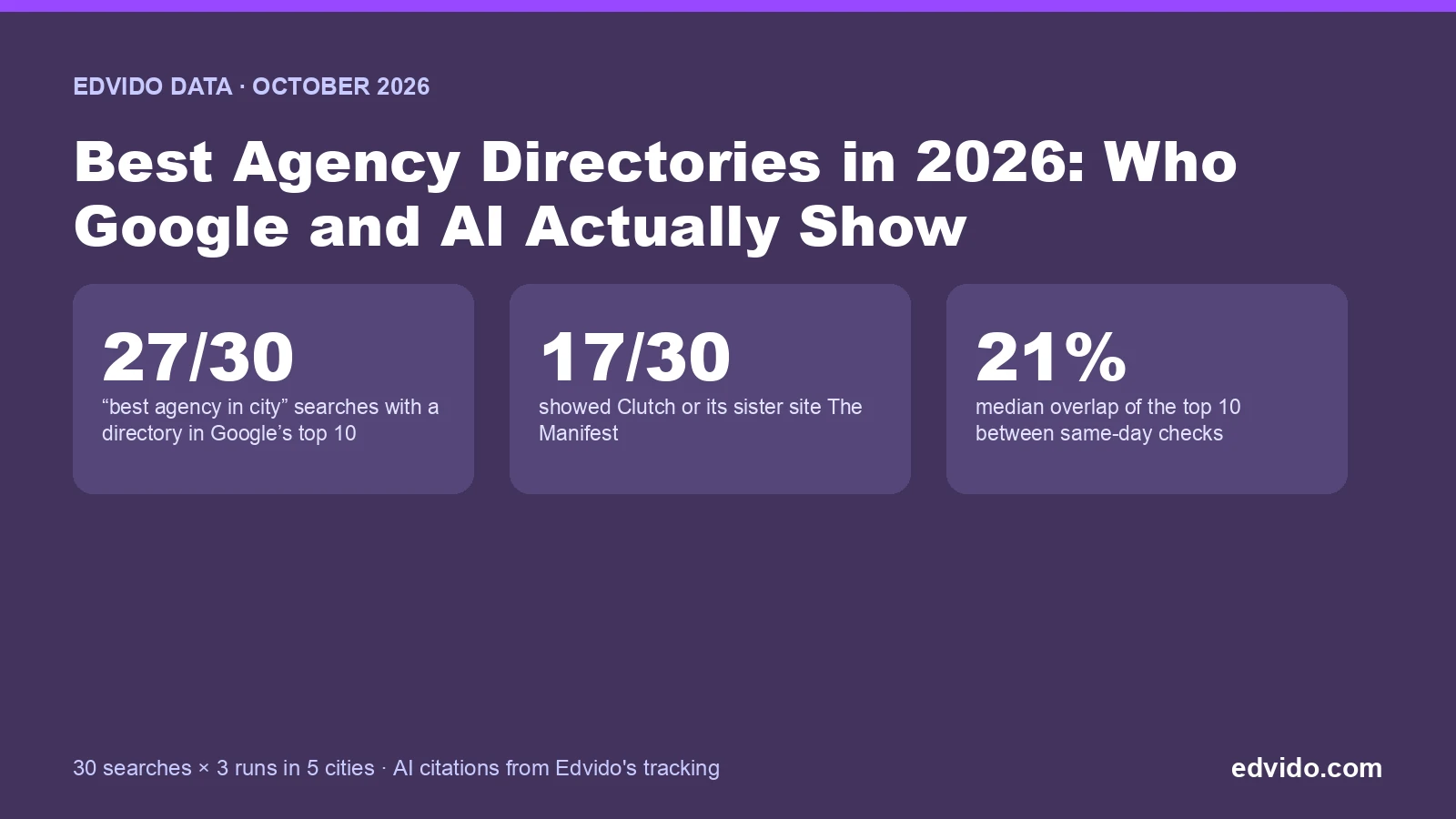
A 4.9-star profile feels like evidence. Often it's a handful of happy clients on a platform you've never checked, sorted to the top by a sponsorship you didn't notice. If you're still deciding which agency directories to use and how they order their lists, start there. Here we test the reviews themselves.
Why a star average misleads more than it informs
Agencies aren't restaurants. A busy agency might serve a few dozen clients a year, and few reviews push an average to the extremes. One delighted client produces a perfect 5.0.
Count: small samples swing hard
A hypothetical example: Agency A shows 5.0 from three reviews, Agency B shows 4.7 from a much larger base. Most buyers click A, yet only B's rating has survived many clients, unhappy ones included.
Recency: whose work are you reading about?
Sort reviews by newest. If nothing has been posted in the last 12 months, the rating may describe a team that no longer exists.
Distribution: the critical reviews carry the information
Identical five-star reviews tell you less than a few threes and fours. Critical reviews, and the agency's replies, show how it behaves when something breaks.
Bayesian adjustment: some platforms already correct for small samples
Some platforms blend every rating with a baseline, as if a few "average" votes were already cast. Profiles with few reviews get pulled toward it; as reviews accumulate, the real average takes over.
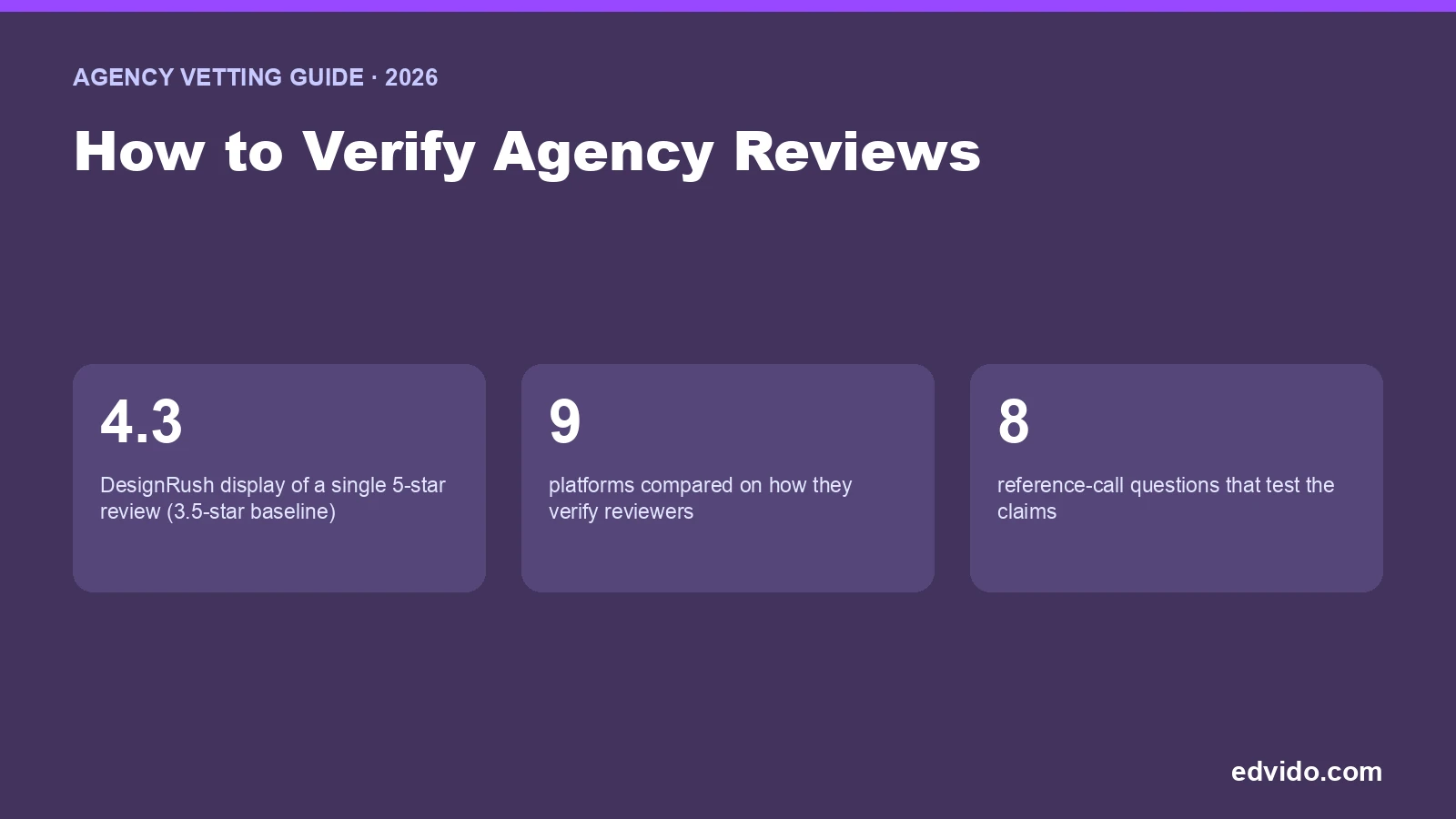
DesignRush explains this on its methodology page: it adds a 3.5-star rating to all profiles as a smoothing baseline. In its own example, an agency with a single five-star review shows 4.3 stars, while an agency with twenty-nine five-star reviews still shows 5. Trustpilot's Trust Centre describes a similar idea: its TrustScore uses the number of reviews, their age and a weighting that includes seven reviews at 3.5 stars.
How each platform verifies reviews (and whether payment moves the order)
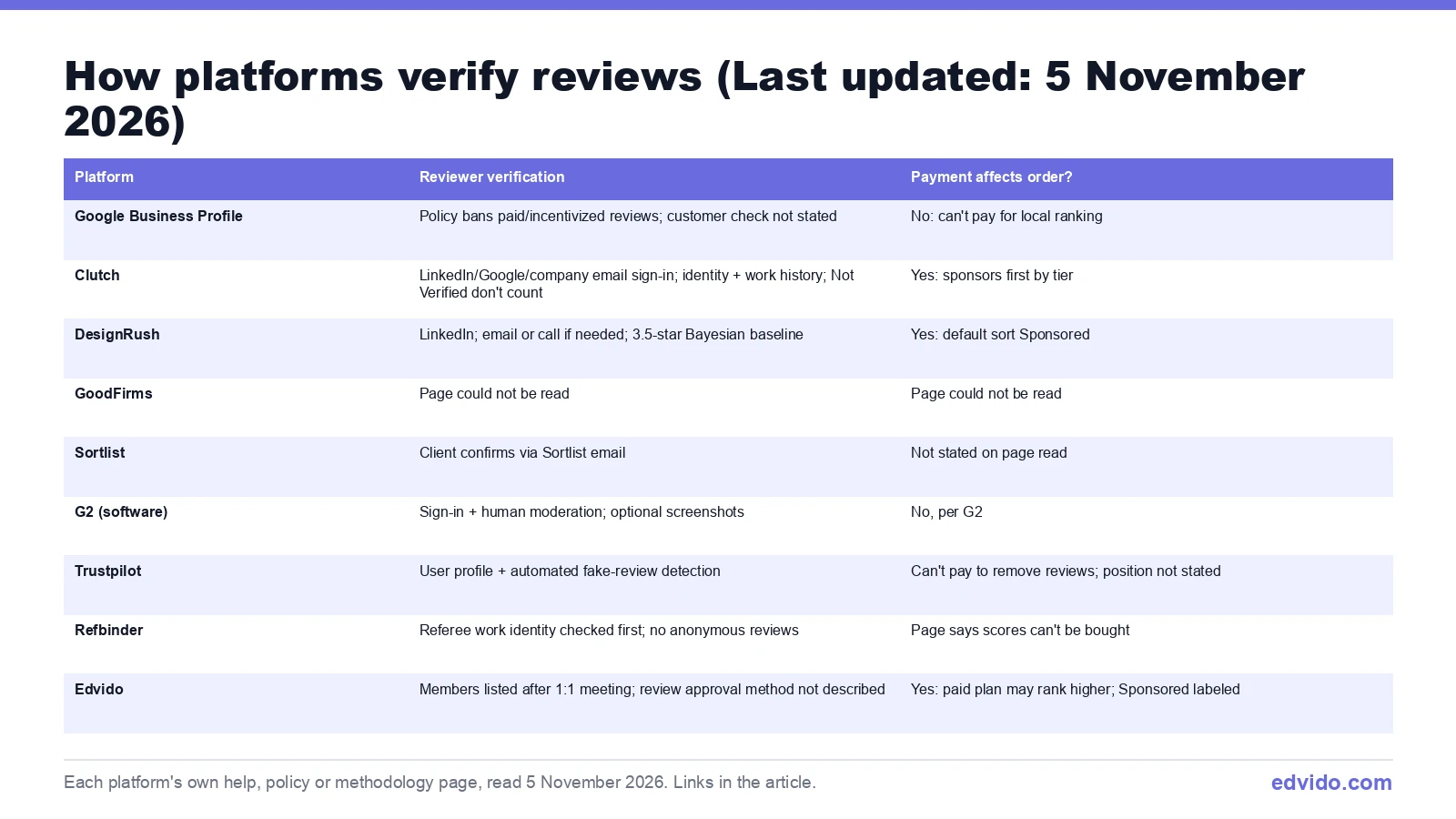
"Verified client reviews" doesn't mean the same thing everywhere. One platform checks the reviewer's work identity; another sets a policy and filters suspicious patterns. The table uses only what each platform states on its own help, policy or methodology pages. Where we couldn't read a page, we say so instead of guessing.
Last updated: 5 November 2026
| Platform | How reviewers are verified | Does payment affect order? | Source |
|---|---|---|---|
| Google Business Profile | Policy bans paid, incentivized and conflict-of-interest reviews and flags unusual review patterns. Confirming the reviewer was a customer: not stated on the page we could read. | No. Google says there's no way to request or pay for a better local ranking. More reviews and positive ratings can help local ranking. | Contribution policy · Local ranking |
| Clutch | Sign-in via LinkedIn, Google or company email; identity and work history checked; method specifics not shared. Unverifiable reviews are published as "Not Verified" and don't count toward score or rankings. | Yes. Sponsors appear first by tier, then Clutch Verified non-sponsors, then everyone else. | Verification · Not Verified · Order |
| DesignRush | Each reviewer is authorized through LinkedIn; where necessary, verified by email or call. Ratings use a 3.5-star Bayesian baseline. | Yes. Default sort is "Sponsored"; sponsored listings pay to appear above organic positions. The page says sponsorship doesn't affect star ratings or review content. | Methodology · Sample list |
| GoodFirms | Not stated on the page we could read (its help pages returned an access error on 5 November 2026). | Not stated on the page we could read. | Help page (blocked) |
| Sortlist | Clients invited by the agency must confirm the review via a button in a Sortlist email; reviews imported from other sites must be accepted by the client. No further checks described. | Not stated on the page we could read. Its profile guide cites needs, budget, location and fresh content; its ranking article returned an error. | Reviews · Ranking |
| G2 (software, not agencies) | Sign-in via LinkedIn, business or personal email; human moderation of every review; optional private screenshots earn "Verified Current User". | No, per G2: paying doesn't improve a product's ranking and G2 doesn't support pay-for-placement. | Authentic reviews · Rankings |
| Trustpilot | Every review is tied to a user profile and screened by automated fake-review detection; flagged reviews go to human teams. | Businesses can never pay to remove reviews. Whether paid plans affect position is not stated on the page we could read. | Trust Centre |
| Refbinder (Turkey, B2B references) | The referee's work identity (company email, LinkedIn, role confirmation when needed) is checked before the process starts; no anonymous reviews; profiles get a freshness check every 60 days. | The page says companies can't buy scores and there's no paid profile advertising or featured-placement fee. Its revenue model is not stated. | About page |
| Edvido | Members are listed after a one-to-one meeting with our team. The Google rating is Google Maps' public rating. How client reviews are approved isn't described on our methodology page. Non-member listings aren't verified. | Yes. A paid membership plan may place an agency higher; the team can adjust order manually; weights aren't published. Ads carry a "Sponsored" label. | Methodology · Transparency |
When you see "verified," ask what was verified: the reviewer's identity, the company's registration, or only that an email address works. Paid placement isn't a scandal in itself; what matters is whether the platform says so plainly and labels it.
Want a shortlist matched to your actual project instead of a sponsored list? Send your brief, get matched right away, completely free.
Get matched freeIs Clutch legit? A fair reading
Yes, Clutch reviews come with a published verification process. Know what it covers before treating a profile as proof.
Clutch's help center says reviewers sign in with LinkedIn, a Google account or a company email, and Clutch checks proof of identity and work history, emailing the reviewer if details are missing. It doesn't provide specifics about its methods, so you're trusting a process you can't fully inspect.
When Clutch can't confirm a reviewer's identity, work history or project, it may still publish the review, marked Not Verified. According to Clutch, Not Verified reviews don't affect the provider's Clutch score or directory rankings. They still sit on the profile, though.
The order is what most buyers miss. On default lists, sponsors appear first by tier, then Clutch Verified companies not sponsoring that page, then everyone else. The Clutch Verified badge is a company check: business registration (Secretary of State for US firms), legal and financial records via CreditSafe data, and client reviews.
- Position: Assume the top of a default list is sponsored until you see otherwise.
- Badge: "Clutch Verified" checks the company's registration and records, not the quality of its work.
- Reviews: Count only reviews without the Not Verified label, and note their dates.
So, is Clutch legit? As client feedback with stated identity checks, yes. As a ranking of quality, no; its own ordering rules make that plain.
Checking a portfolio or case study against reality
A review is someone's opinion. A case study is the agency's claim. Both can be tested, and the case study is often easier.
Pick three portfolio pieces and find them in the wild: the website should load, the campaign should be on the brand's channels, the app should be in the store. One retired project isn't a red flag. A portfolio you mostly can't find is.
Next, pin down the role. Big brands often use several agencies at once, so a client logo doesn't say which slice the agency handled. Site footers, award entries and the brand's own announcements often name who did what.
Our guide on how to choose a digital marketing agency covers reading case studies in depth. For verification the point is narrower: every number in a case study is a claim you can read back to a reference.
- Logo wall with no project details
- Mockups and screenshots only
- Undated work
- "Brands we've worked with," no role stated
- Live work you can open
- The agency's role spelled out
- Launch date and duration
- A named contact you can call
The agency references check: 8 questions that test the claims
Treat a reference call as a fact check, not a vibe check. Write down what the agency told you (case study numbers, review text, team names) and read it back. The agency picked this reference, so "were you happy?" always gets a yes; skip it.
- "What was your role, and did you work with the agency directly?" Confirms you're talking to someone who saw the work, not a signatory.
- "Their case study says [result]. Does that match your numbers?" Read the claim back word for word. Hesitation or a different baseline is a finding.
- "Which parts did they do, and which were in-house or another vendor?" Checks the portfolio's implied scope.
- "When did the engagement start and end?" Compare with the review date and the case study timeframe.
- "Did they ask you for a review, and was anything offered in return?" A discount for a review is an incentive the platforms ban.
- "Did you write the review yourself?" Agency-drafted reviews aren't always fake, but you should know.
- "Are the people who did your work still at the agency?" A great review of a departed team doesn't transfer.
- "Is there anyone else at your company who worked with them?" A second voice the agency didn't choose is worth more than the first.
Before the call, confirm the reference works where they say they do; a company email domain or LinkedIn profile is enough. It's the check Clutch, DesignRush and Refbinder say they run on reviewers.
Red flags of fake or incentivized agency reviews
No single sign proves a review is fake. Two or three together mean you need more evidence.
Google's contribution policy treats reviews paid for "directly or in kind," content posted because a business offered an incentive, content based on a conflict of interest (including current or former employment) and "unusual volumes or patterns of review contributions" as violations. Those definitions double as a checklist for fake agency reviews.
In the US there's also a legal line. The Federal Trade Commission announced a final rule banning fake reviews and testimonials on 14 August 2024. It covers fake reviews (including AI-generated ones), incentives conditioned on positive or negative sentiment, undisclosed insider reviews, review suppression through threats, and company-controlled sites posing as independent. The FTC can seek civil penalties against knowing violators.
What "verified" means on Edvido, and what it doesn't
We run a directory too, so the honest answer has to include our limits. Edvido is a digital smart platform designed to connect businesses with service providers in digital marketing, advertising and software. We're not an agency and we don't do the work.
What it means
Member agencies can't self-register. An agency applies for free and is listed only after a one-to-one meeting with the Edvido team; that meeting is what "verified" refers to. The full flow is on our how it works page.
The Google rating on a profile isn't ours. It's the public Google Maps rating, shown under a "Google Reviews" heading, so the count, recency and distribution rules apply.
What it doesn't mean
Being listed isn't a quality guarantee. Our listing methodology says we don't measure the quality or results of an agency's work, the accuracy of its stated prices, or its financial standing, licences or legal compliance.
Approved client reviews are one ordering signal, but our methodology page doesn't describe how they're confirmed. We'd rather say so than imply a process you can't see.
Non-member companies on some city and district pages come from public business listings, appear after members and aren't verified by Edvido.
List order and matching are separate: briefs are matched on service type, scope and budget. Brands pay nothing; revenue comes from agencies, with 0% commission on contracts, per our transparency page.
For scores with published weights, our global city pages carry the Edvido Agency Index: 100 points across six categories, each item marked verified, partial, not found or unverified; agencies on a paid Edvido plan aren't scored. The method is in the Agency Index methodology; it's still a version 0.1 pilot.
A short checklist before you decide
Run these on two or three candidates side by side. Our agency comparison tool puts profiles on one screen, and the digital marketing agencies directory is a starting point by category; list order there isn't a quality score.
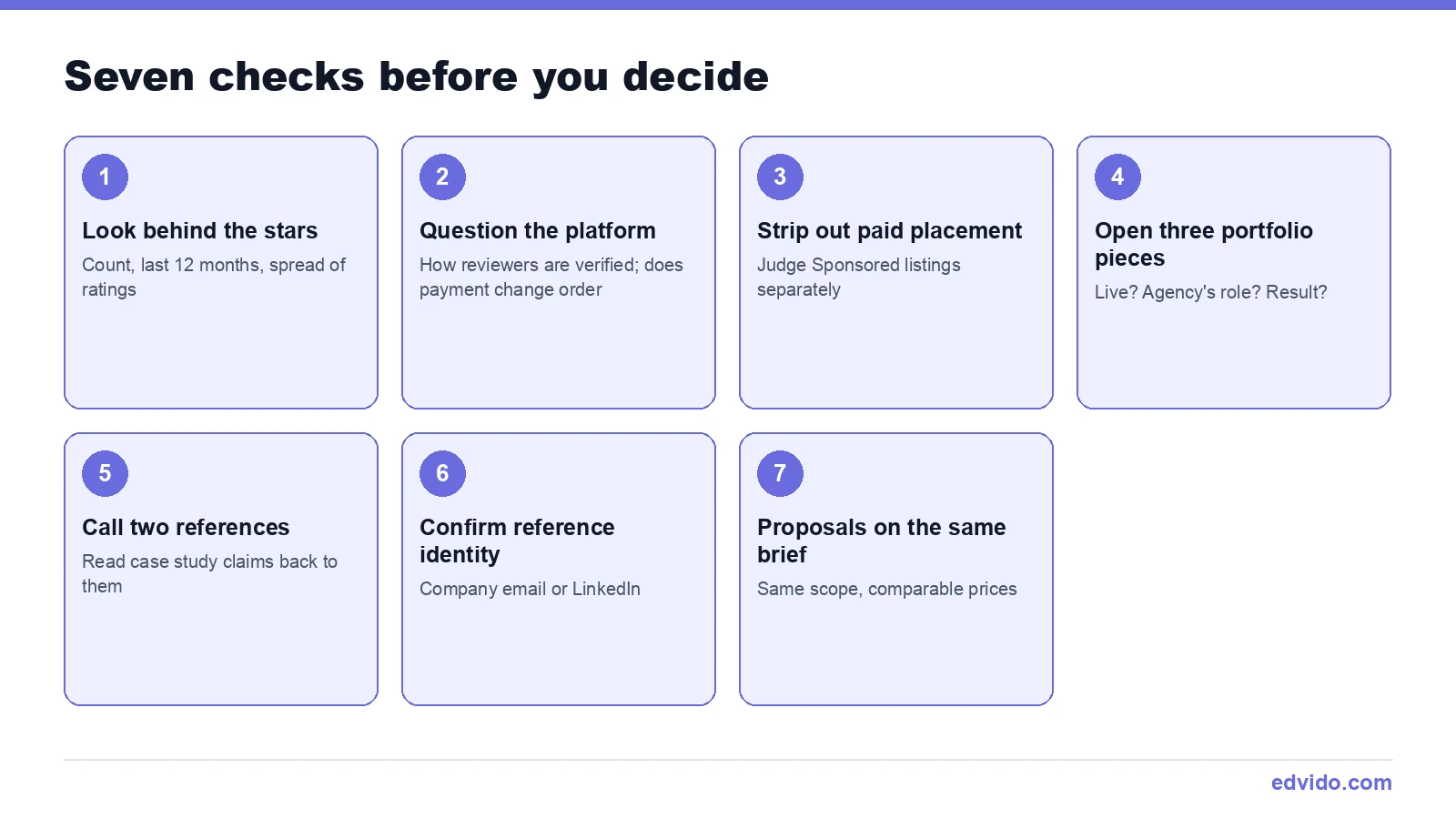
- Look behind the stars. Note review count, reviews from the last 12 months and the spread of ratings.
- Question the platform. How does it verify reviewers, and does payment change the order?
- Strip out paid placement. Judge "Sponsored" or tiered listings separately from organic order.
- Open three portfolio pieces. Is the work live, what was the agency's role, what happened?
- Call two references. Read the case study claims back to them.
- Confirm the reference's identity. Company email or LinkedIn, one minute.
- Request proposals on the same brief. Different scopes make price comparisons meaningless.
The last step is the most skipped: if each agency hears a different version of your project, the proposals don't describe the same job. To see how other businesses handled it, browse our user stories.
Find candidates worth checking. Send your brief, get matched right away, completely free.
Get matched freeFrequently Asked Questions
How do I verify agency reviews quickly?
Check the review count and the last 12 months of reviews, see how the platform verifies reviewers and whether sponsorship changes the order, then call a reference and read a case study claim back to them.
Is Clutch legit?
Clutch is a real review platform with a published verification process: reviewers sign in with LinkedIn, Google or a company email, and Clutch checks identity and work history, though it doesn't share method specifics. Reviews it can't verify are labeled Not Verified and don't affect scores or rankings. Default lists show sponsors first, so list position isn't a quality ranking.
Does paying affect rankings on Edvido?
Yes, it can. An agency on a paid membership plan may appear higher in Edvido's lists, and our team can adjust order within platform rules; we don't publish the weights. Advertised agencies are labeled "Sponsored" and shown separately from the organic order. Brief matching uses service type, scope and budget, not list position.
What does "verified client reviews" actually mean?
It depends on the platform. Clutch checks identity and work history, DesignRush authorizes reviewers through LinkedIn, Sortlist relies on the client confirming by email, and Google's policy bans incentivized reviews without describing a customer check. Always ask what was verified.
How can I spot fake agency reviews?
Look for bursts of five-star reviews, generic praise without project detail, single-review accounts and unanswered criticism. Google's policy bans incentivized reviews, and the FTC's 2024 rule bans fake and undisclosed insider reviews in the US.