When somebody types "looking for a durable ergonomic chair for our new office, budget around $250-300" into ChatGPT, they have just handed over three things at once: what they want, why they want it, and what they can pay. On Google that takes three separate searches and a lot of guessing. For an advertiser, that difference is the whole story.
OpenAI started serving ads inside ChatGPT on 9 February 2026. Self-serve opened to US advertisers on 5 May, the Ads Manager went live on 22 July, and on 31 August access expanded across Europe, India and MENA. In that same announcement OpenAI said ChatGPT Ads had passed a $1 billion annualised revenue run rate in under 200 days. So this is no longer a channel to watch. It is a channel to budget for.
What follows is the practical version: how the placement actually behaves, how to get an account, what it really costs based on published spend data, and where it sits next to Google and Meta. We have kept every number sourced, including the ones that make the channel look worse.
Where the ad actually appears
The most common misunderstanding is that the ad blends into the model's answer. It does not. ChatGPT answers normally, and the ad arrives underneath it as a separate bordered card carrying a "Sponsored" label that cannot be removed.
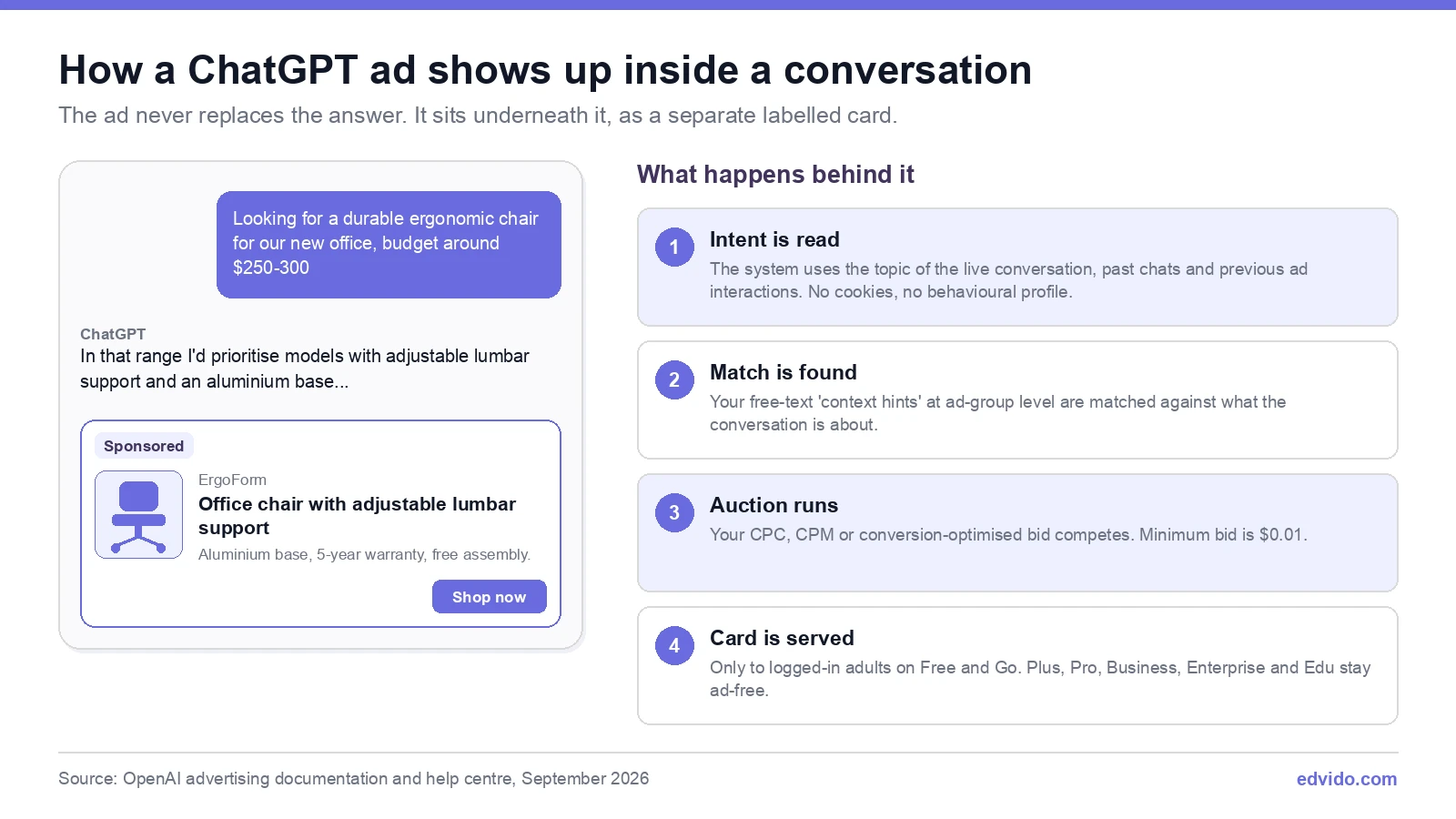
Targeting works on different logic than you are used to. There are no cookies and no behavioural profiles. The system reads the topic of the live conversation, past chats and previous ad interactions, then matches contextually. Ads only reach logged-in adults on the Free and Go tiers. Plus, Pro, Business, Enterprise and Education users never see them.
Can you actually buy? The country question
Seeing ads and buying ads are two different questions, and the second one depends entirely on where your business is registered.
As of 3 September 2026, OpenAI lists 52 countries with self-service access. That includes the United States, Canada, Mexico and Brazil; 31 European markets; India, Japan, Korea, Australia and New Zealand; and 11 markets across the Middle East and North Africa.
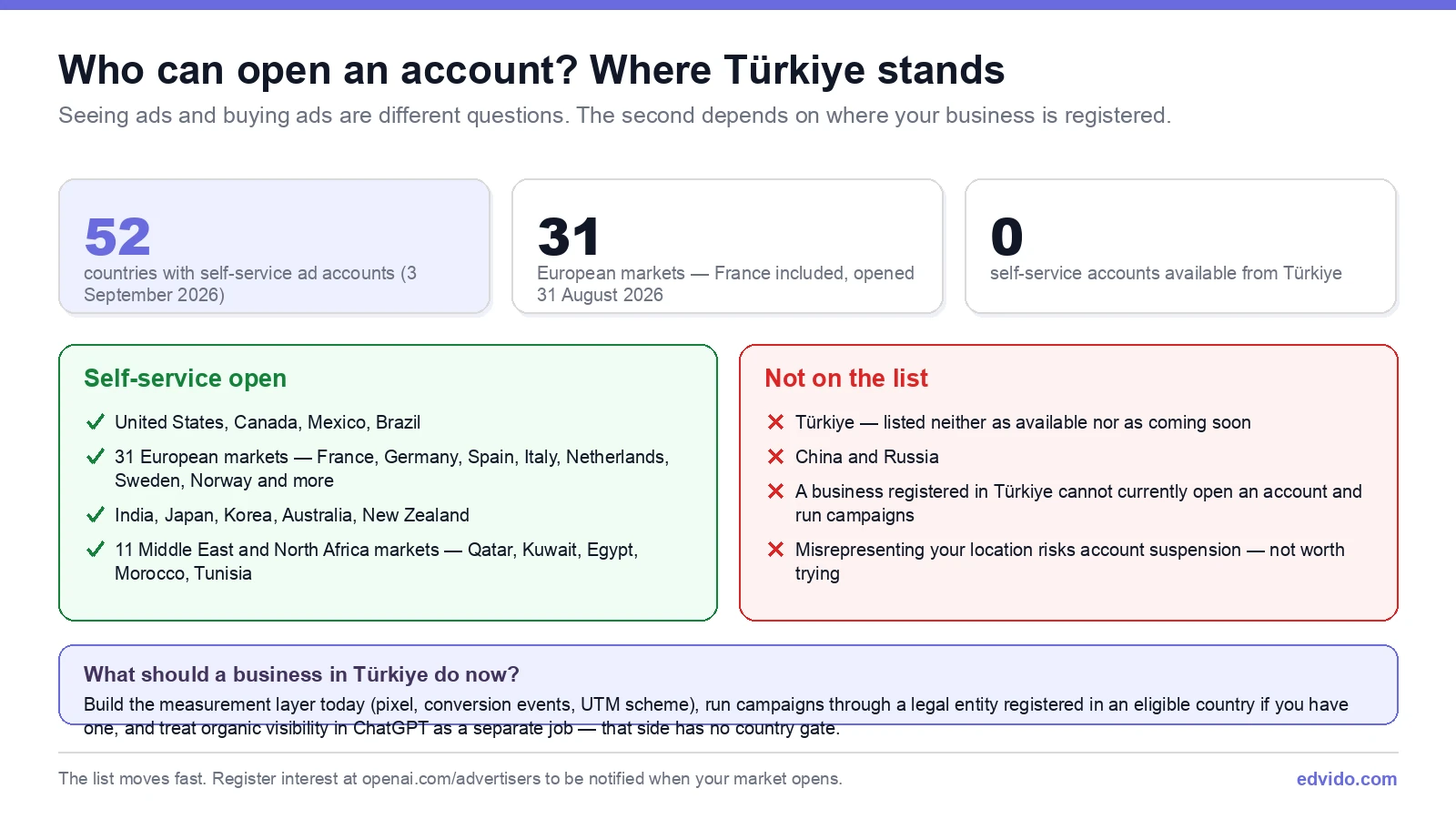
Türkiye, China and Russia are not on the list — neither as available nor as coming soon. If your entity sits in one of those markets, there are three legitimate routes and one that will cost you the account. You can run through a legal entity registered in an eligible country. You can work on a client's account, though the client must open it themselves because agencies cannot create accounts on a client's behalf. And you can register interest at openai.com/advertisers to be notified when your market opens.
The route to avoid is declaring a country you are not in. Misrepresenting location risks suspension, and suspension takes your live budget with it.
Account setup: five steps and two permanent decisions
Everything runs through ads.openai.com. The flow rhymes with Google Ads, then breaks from it hard in two places.
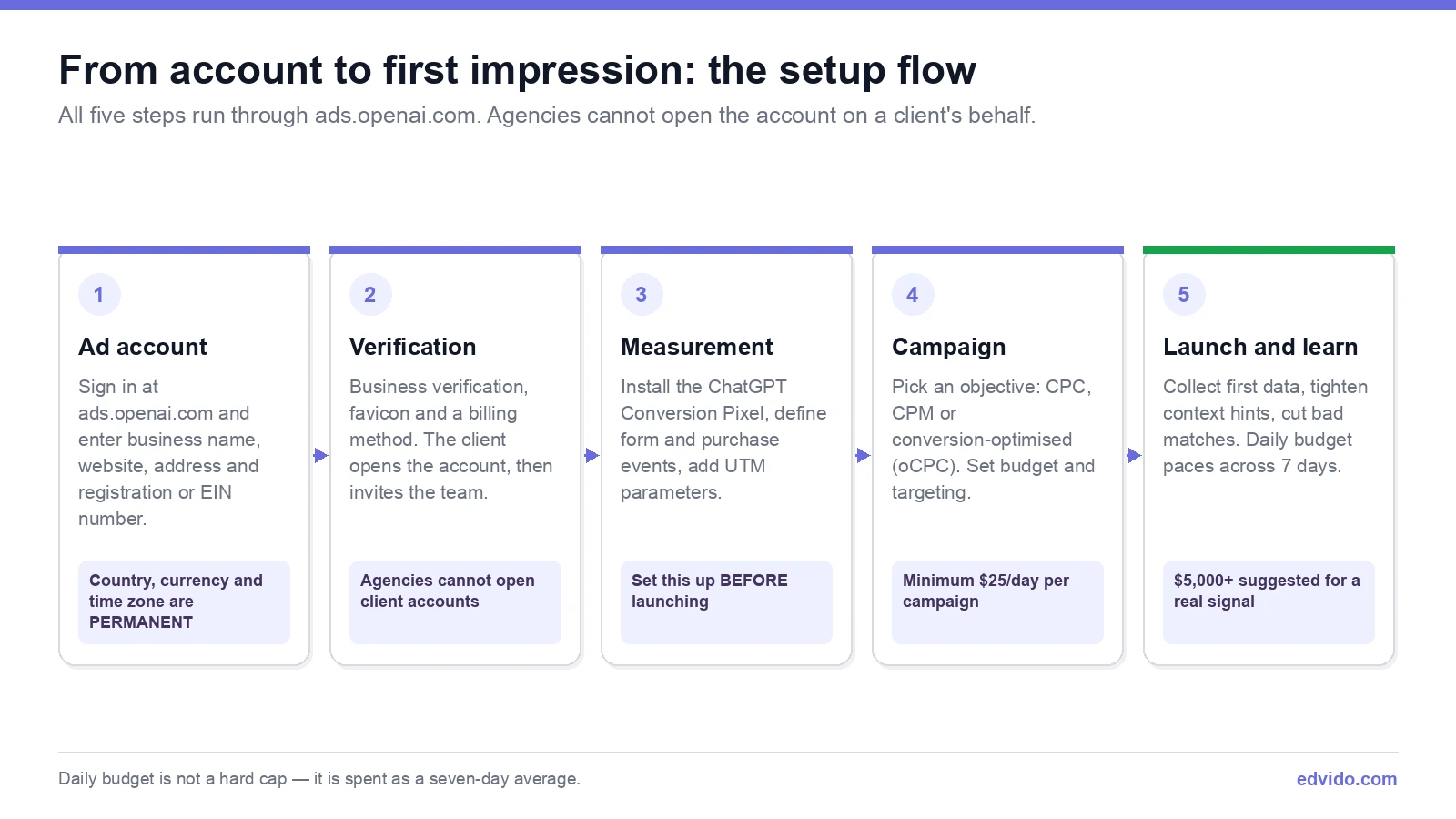
- Open the ad account. You will need business name, website, address and a registration or EIN number. Country, currency and time zone cannot be changed afterwards. Get one wrong and your only fix is a new account.
- Clear verification. Business verification, favicon and a billing method. The client opens the account and then invites team members and their agency. An agency cannot open it for them.
- Install measurement. Place the ChatGPT Conversion Pixel, define your form and purchase events, and settle your UTM scheme. Leaving this until after launch throws away the first week of learning data.
- Build the campaign. Pick CPC, CPM or conversion-optimised (oCPC). Minimum daily budget is $25 per campaign; minimum bid is $0.01.
- Launch and narrow. Collect the first data, sharpen your context hints, cut bad matches. Remember the daily budget is not a hard cap — it paces as a seven-day average and some days will run over.
Campaign structure: what lives at each level
Three levels, but the weight sits differently than in Google Ads. The campaign level is nearly empty. The ad group is where the work happens.
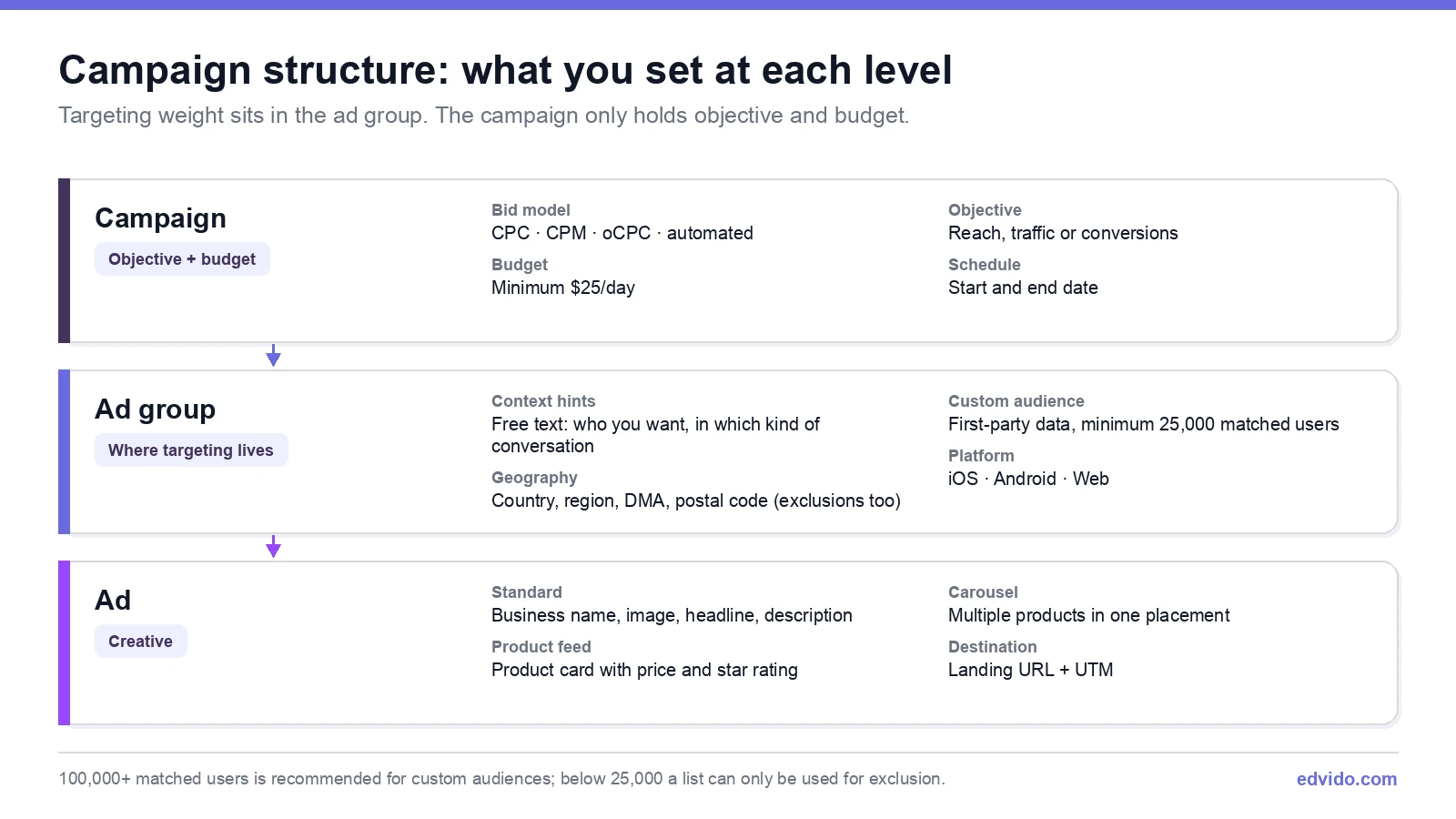
The "context hints" field inside the ad group is the single most important box on the platform, and the most underestimated. It is not a keyword list. It is free text where you describe, in sentences, who you want and what kind of conversation you want to catch them in.
We see two opposite failures here. Some accounts write something enormous like "small business owners" and burn the budget across irrelevant chats. Others write something so narrow it never serves. The version that works describes a situation, not a persona.
- "SMB owners"
- "People looking for accounting software"
- "Managers aged 35-50"
- Describes a person, not a conversation
- "Business owner who has outgrown tracking receivables in a spreadsheet and is asking about e-invoicing integrations"
- "Someone unhappy with their current bookkeeping tool and comparing alternatives"
- Describes a problem and the moment it gets discussed
Geographic targeting runs at country, region, DMA and postal code level, with exclusions available. Custom audiences need at least 25,000 matched users from your first-party data, and OpenAI recommends 100,000 or more. Lists below 25,000 can only be used for exclusion — which is enough to suppress existing customers, but not enough to target them.
Ad formats and the brutal creative limits
Three formats exist: the standard ad, the product feed ad and the multi-product carousel. All of them sit on one base unit, chat_card — one headline, one description, one image, one destination URL.
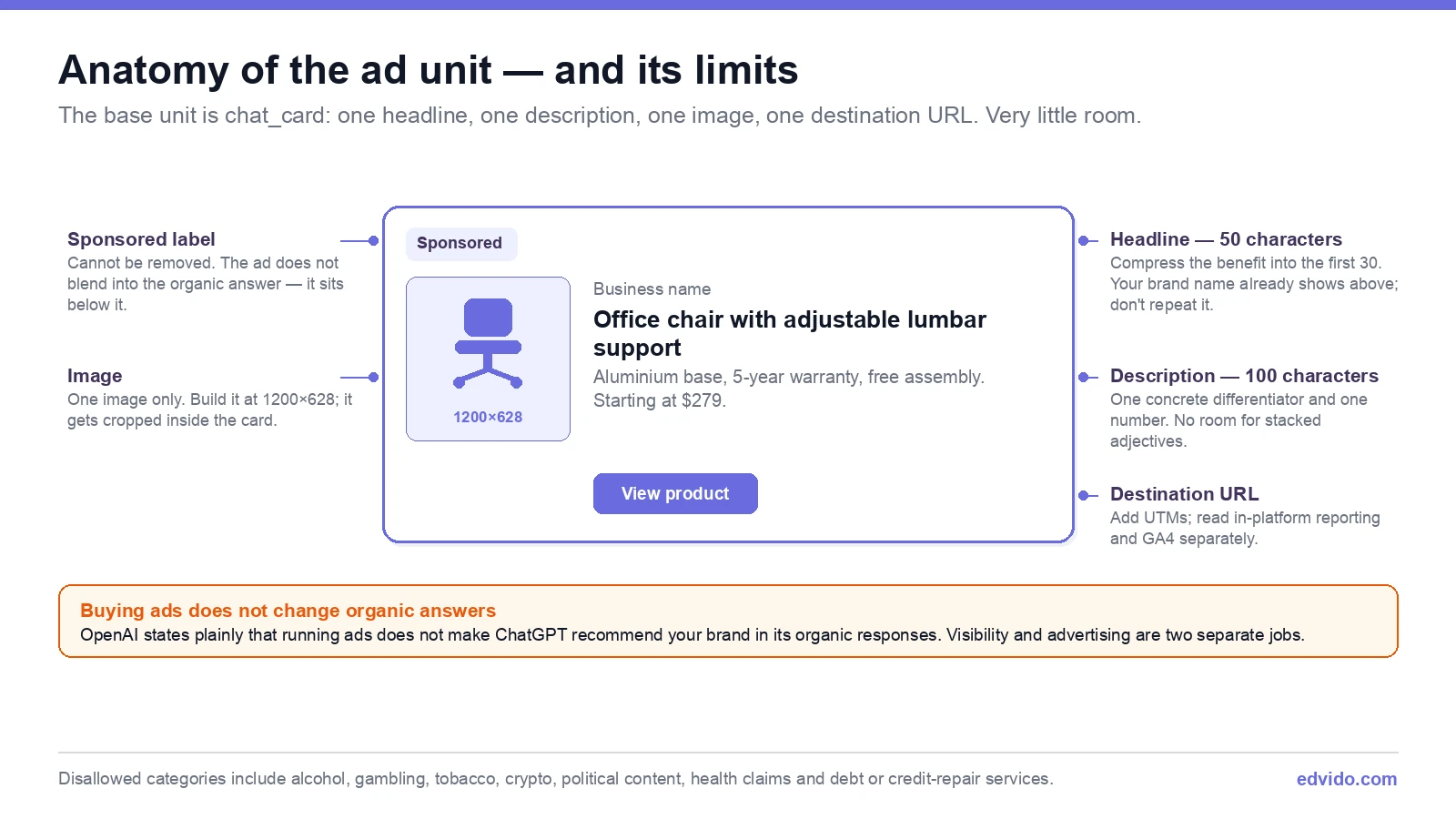
You get 50 characters of headline and 100 characters of body. For teams used to juggling three headlines and two descriptions in Google Ads, that compression is genuinely jarring. The rules that survive it: compress the benefit into the first 30 characters, never repeat your brand name in the headline because it already prints above the card, and put exactly one concrete differentiator and one number in the description.
Build images at 1200×628 and keep anything critical away from the edges, since the card crops. Text baked into the image does not survive at this size.
The policy list is not narrow either. Alcohol, gambling, tobacco, crypto, political content, health claims and debt or credit-repair services are disallowed outright. Finance, healthcare and legal sit in a limited category — permitted, but subject to extra review.
What it really costs
OpenAI suggests an opening bid of $3-5 per click, and reported CPMs land in a $25-60 band. Minimum daily spend is $25 per campaign, though nobody collects a usable signal at that level.
From here we can stop estimating. A team at Opascope published a full 15-day window of live spend, and it remains one of the most concrete public records of how this channel behaves right now.
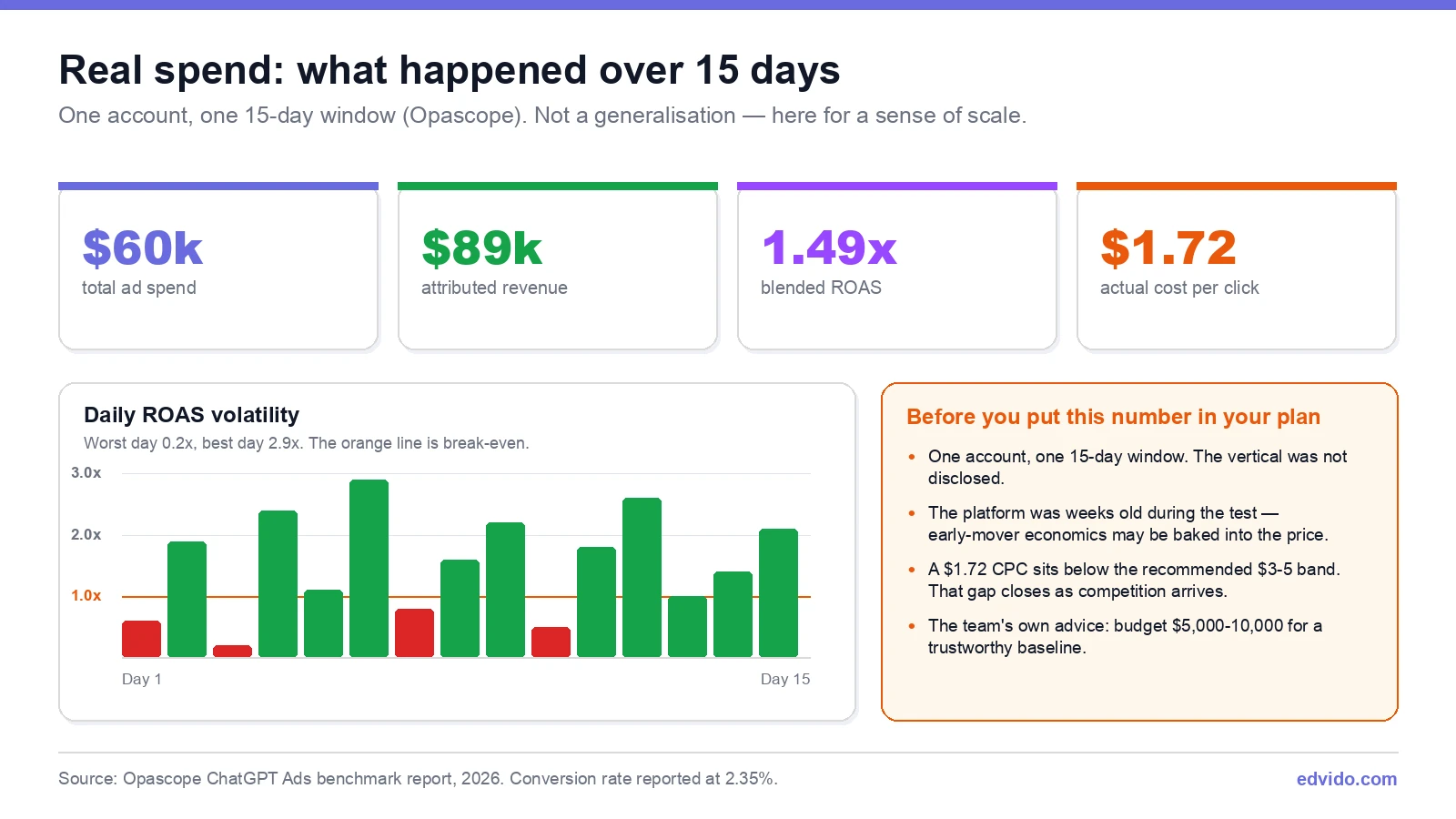
Roughly $60,000 spent, roughly $89,000 in attributed revenue, a 1.49x blended ROAS, an actual CPC of $1.72 and a 2.35% conversion rate. The channel made money. But the instructive part is not the averages — it is the daily swing, from 0.2x on the worst day to 2.9x on the best.
That volatility has a direct operational consequence. You cannot judge this channel on three days of data. Killing a campaign after three bad days and doubling the budget after three good ones are the same mistake wearing different clothes.
If you want a structured way to size that budget, the method in our Google Ads pricing and budgeting guide transfers cleanly — just stretch the learning window.
ChatGPT Ads vs Google, Meta and TikTok
Judging this channel on one metric produces the wrong answer every time. ChatGPT ads have a low click-through rate and a high conversion rate. Read either number alone and you can tell whatever story you prefer.
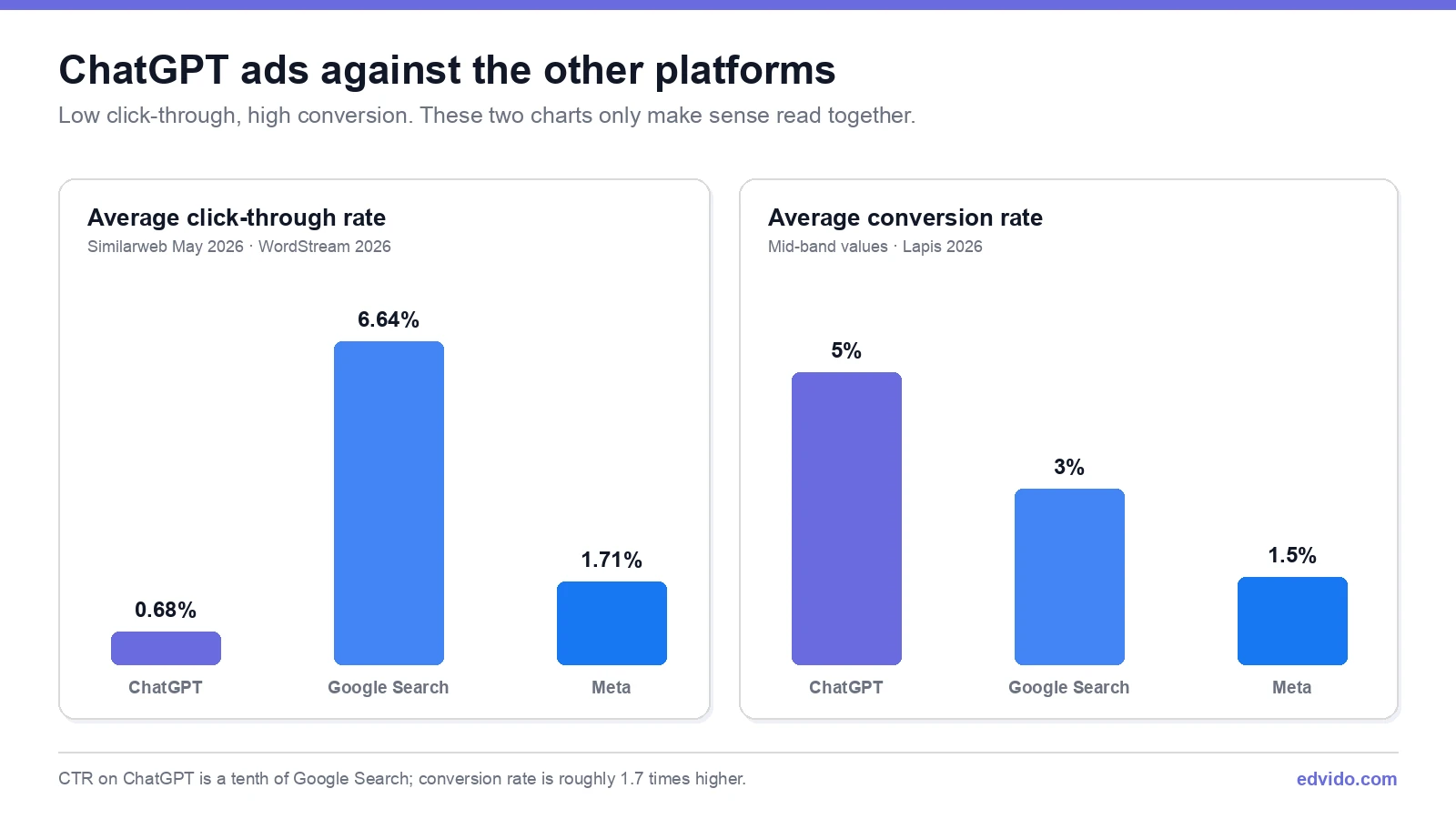
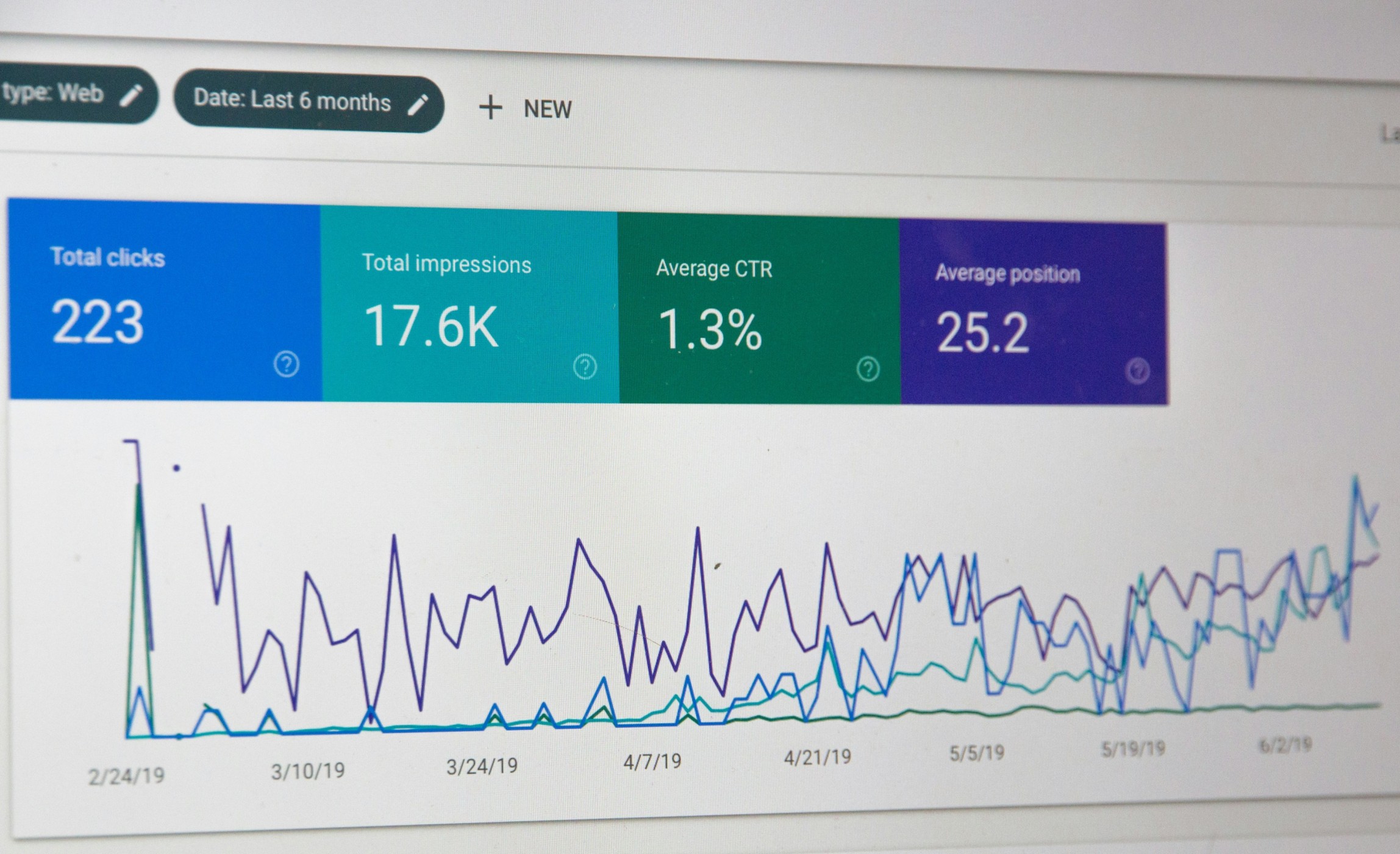
Similarweb's May 2026 analysis puts average ChatGPT ad CTR at 0.68%, with the top quartile reaching 1% and the best brands hitting 1.57%. WordStream's 2026 benchmarks put Google Search at 6.64% and Meta at 1.71%. On clicks, ChatGPT runs at roughly a tenth of Google Search.
Conversion flips the picture. The person clicking has already qualified themselves out loud — they told the model their budget, their constraint and their use case before they ever saw your card.
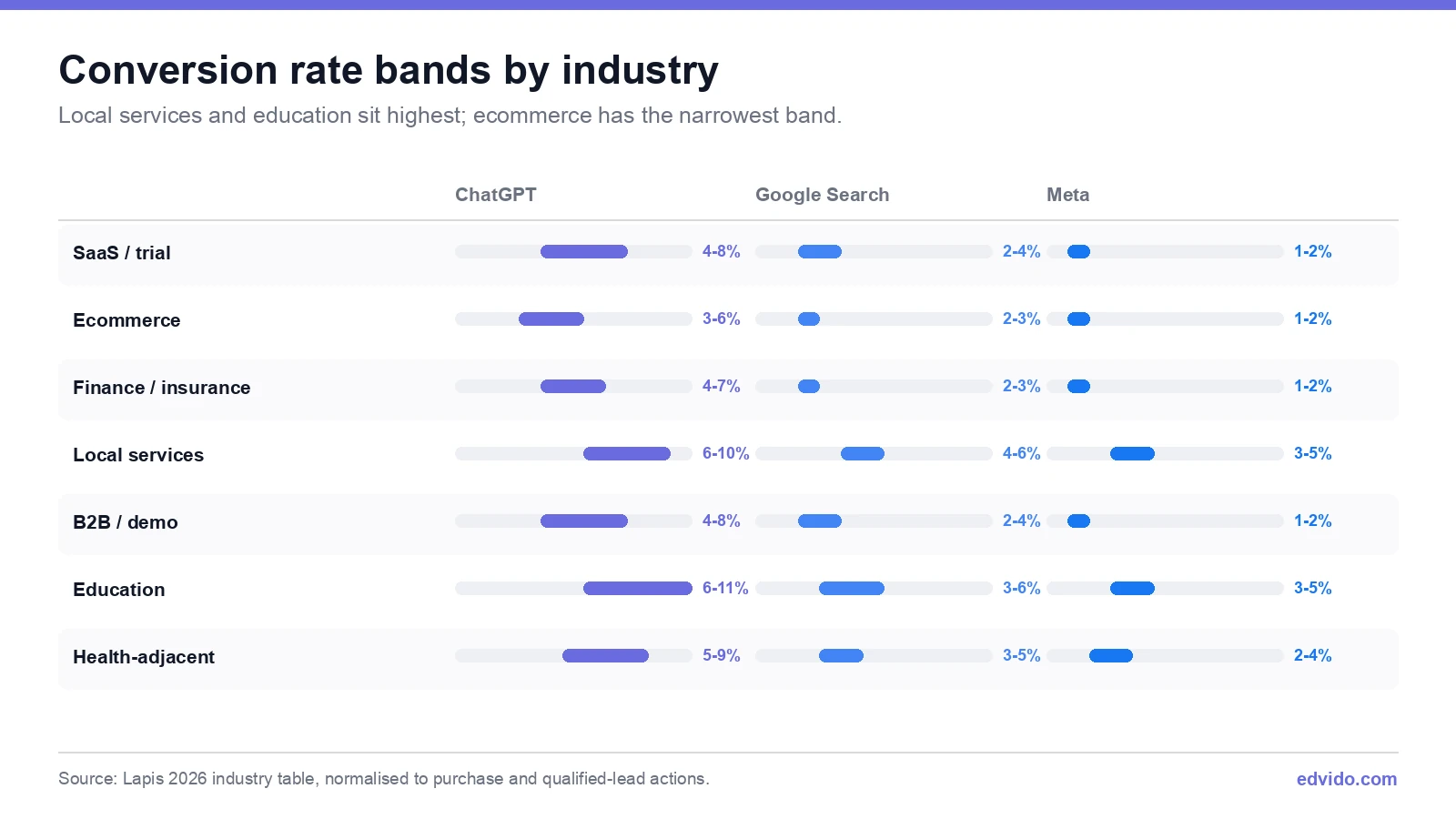
Education and local services sit at the top, which is no accident: both are categories where buyers compare out loud and move forward by asking questions. Ecommerce sits in the narrowest band, because shoppers research with the model and then complete the purchase somewhere else entirely.
Put the same budget through all three and the trade becomes visible.
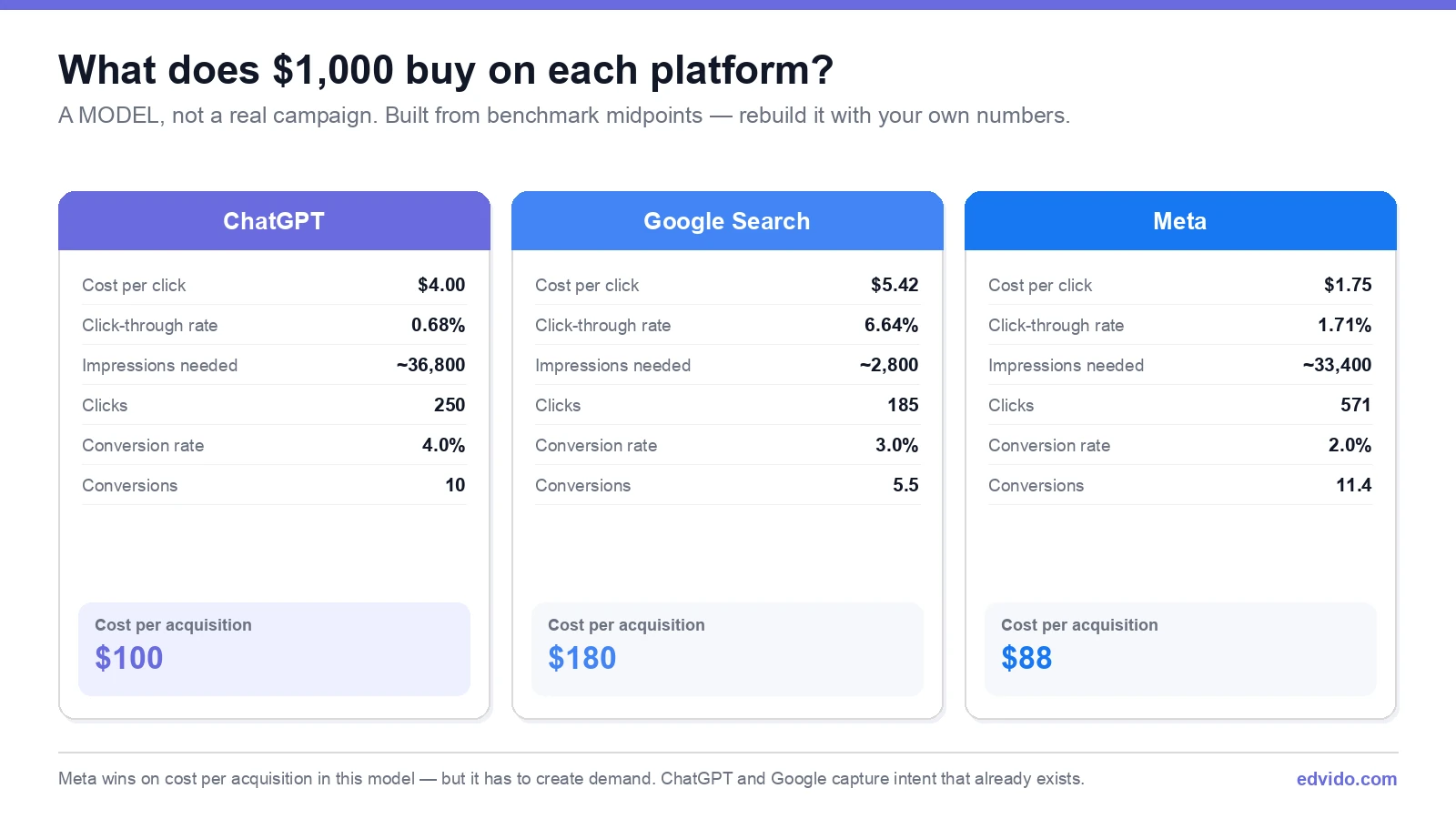
That is a model built from benchmark midpoints, not a real campaign. The row worth staring at is "impressions needed". Getting 250 clicks on ChatGPT takes roughly 36,800 impressions; Google Search delivers 185 clicks off 2,800. That tells you how wide your inventory has to be. Target a genuinely narrow niche and you may simply fail to find enough impressions to spend your budget.
| Criterion | ChatGPT Ads | Google Ads | Meta | TikTok |
|---|---|---|---|---|
| Intent level | Very high, context-rich | High, keyword-based | Low, creates demand | Low, discovery-led |
| Average CTR | 0.68% | 6.64% | 1.71% | Highly creative-dependent |
| Creative space | 50 + 100 characters, one image | Multiple headlines and descriptions | Wide, video included | Video only |
| Targeting logic | Free-text context hints | Keywords and match types | Interests and behaviour | Interests and lookalikes |
| Maturity | Born 2026, tooling is thin | Two decades, very deep | Very mature | Mature |
| Search-term report | None | Yes | Not applicable | Not applicable |
Testing four channels on your own is an expensive way to learn which one fits. Compare verified agencies on Edvido and collect proposals at no cost.
Get a Free OfferMeasurement: know why the numbers disagree
The ChatGPT Conversion Pixel captures form submissions, orders and whatever else you define. In-platform reporting gives you impressions, clicks, conversions, attributed sales value, ROAS, CTR, average CPC and average CPM. Automatic Advanced Matching uses hashed customer data from your forms to lift match rates.
Here is the trap. The platform counts view-through conversions within one day of an impression. GA4 does not. A gap between the two reports is not a bug, it is a definitional difference. Decide which number governs the campaign before you launch, then stay with it.
On the third-party side, UTM parameters connect you to GA4, AppsFlyer and Adjust. Note also what the platform will not give you: there is no search-terms report, and it does not disclose which prompts triggered your ad. You optimise by rewriting context hints and measuring the result, not by pruning a query list.
A sane first 30 days
- Day 0 — freeze measurement. Do not launch without the pixel, the events and the UTM scheme. Write down which metric decides: CPA or ROAS.
- Days 1-7 — start wide, run two ad groups. One narrow context hint, one broad. Keep the creative identical so the variable stays in the hint.
- Days 8-14 — test creative, freeze targeting. Two headline and description variants. Changing two things at once hides which one worked.
- Days 15-21 — deepen the winner. Split the winning hint into a tighter second variant and switch off the loser.
- Days 22-30 — close the unit economics. Put your CPA next to Google and Meta. That is where you see whether an expensive click is paid back by a high conversion rate.
- Budget: anything under $5,000 is a demo, not a test.
- Duration: daily ROAS swings between 0.2x and 2.9x; readings under 30 days mislead.
- One variable: never change context hints and creative in the same week.
- Deciding metric: judge on CPA, not on click-through rate.
Four mistakes we keep seeing
Because the channel is new, old habits get carried across unchanged. Four stand out.
The first is pasting in Google Ads creative. Squeezing a 90-character description into 100 characters does not work, because this reader has already received a detailed answer from the model. Your ad's job is not to inform. It is to show that you meet the criteria already stated in that answer.
The second is killing the campaign because CTR looks bad. 0.68% is normal here. Comparing it to Google's 6.64% and panicking means pulling the plug before any conversion data exists.
The third is deferring measurement. Every day without the pixel is learning data you cannot recover.
The fourth is confusing paid placement with organic recommendation. Spending ad budget and then checking whether ChatGPT "recommends us now" is trying to solve two jobs with one line item. If AI-driven channels are new territory for your team, what an AI agency actually does is a useful orientation, and our roundup of digital marketing tools covers the measurement stack you will need either way.
If you would rather not run the first test in-house, you can compare performance marketing agencies for the media-buying side, browse AI agencies for teams already working inside these platforms, or look at digital marketing agencies for broader scope. Our list of the best Google Ads agencies is a reasonable shortlist too, since most teams running ChatGPT Ads today came from paid search.
Frequently Asked Questions
How much do ChatGPT ads cost?
OpenAI recommends an opening bid of $3-5 per click, and reported CPMs sit in a $25-60 band. The minimum daily budget is $25 per campaign and the minimum bid is $0.01. In one published 15-day test the actual CPC came in at $1.72. For a baseline you can act on, budget $5,000-10,000.
Which countries can advertise on ChatGPT?
As of 3 September 2026 there are 52 self-service countries: the US, Canada, Mexico and Brazil, 31 European markets, India, Japan, Korea, Australia and New Zealand, plus 11 Middle East and North Africa markets. Türkiye, China and Russia are not on the list. Eligibility follows where your business is registered, not where you are sitting.
Who sees ads in ChatGPT?
Only logged-in adult users on the Free and Go tiers. Plus, Pro, Business, Enterprise and Education remain ad-free, so your addressable audience is meaningfully smaller than ChatGPT's total user count.
Are ChatGPT ads better than Google Ads?
They do different jobs. Google Search has roughly ten times the click-through rate (6.64% versus 0.68%) and far deeper inventory. ChatGPT converts 1.5 to 2 times better by industry, because users clarify their needs in conversation before they click. The sensible move is not to replace Google but to add ChatGPT to the mix as a measured test line.
Does advertising make ChatGPT recommend my brand?
No. OpenAI states that running ads does not influence organic responses. Earning mentions in the model's answers is a separate discipline, and unlike ads it carries no country restriction.
Can an agency open a ChatGPT Ads account for a client?
No. The client must create the account themselves and then invite the agency and team members into it. Country, currency and time zone are locked at creation and cannot be changed later, so confirm those details with the client before anyone clicks through the flow.