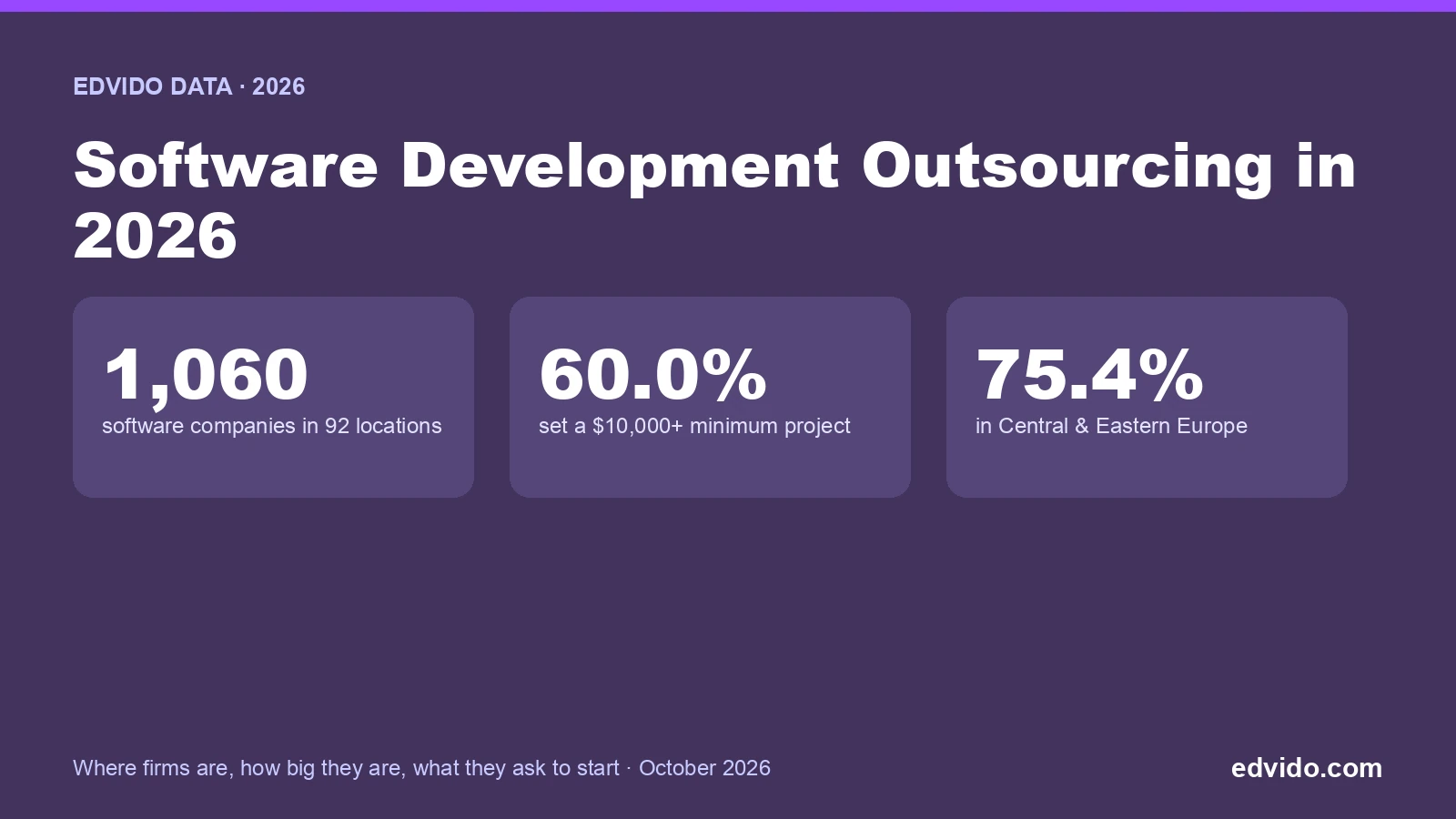
According to Edvido's analysis of 1,060 software development companies listed in 92 locations, 60.0% of the firms that publish a minimum project size ask for $10,000 or more to start, and the median minimum is $10,000. Outsourcing to a cheaper region does not lower that entry point as much as most guides suggest: 75.4% of firms in Central and Eastern Europe and 62.3% in South and Southeast Asia also start at $10,000 or more. The data was collected on 21 October 2026 from the company listings shown on edvido.com.
Most outsourcing guides compare hourly rates by country. Hourly rates matter once you have a contract, but the first question is simpler: which companies will take your project at all? This article answers it with the numbers firms publish themselves: the smallest project they accept, how big their teams are and what else they build. For country-by-country price tables, see our software development pricing report. This guide covers the decision before that: which sourcing model fits your project.
- High entry point: 60.0% of software firms set a $10,000+ minimum and 28.2% ask $25,000+. Across all nine agency types Edvido tracks, only 38.4% start at $10,000+.
- Nearshore is not the budget option: in Central and Eastern Europe 75.4% of firms start at $10,000+, and only 2.9% accept projects of $1,000 or less.
- Lowest entry points: the Middle East, Türkiye and Africa group has the most firms at $1,000 or less (29.2%) and a median minimum of $5,000.
- Bigger firms offshore: 49.6% of South and Southeast Asian software firms have 50 or more people, against 35.0% in the US, UK, Canada and Australia/New Zealand.
- Mobile and web come bundled: 34.8% of software firms also build mobile apps and 32.7% do web development; 7.4% list artificial intelligence.
What is software development outsourcing?
Software development outsourcing means hiring an outside company to design, build or maintain software instead of doing it with your own employees. Companies use it to start faster, to get skills they do not have in-house, or to keep a product team small while a partner handles a defined project.
There are three common sourcing models, defined by where the partner is relative to you:
- Onshore: a firm in your own country. Same time zone, same legal system, usually the highest cost.
- Nearshore: a firm in a nearby country with a small time difference. For Western European and UK buyers this is typically Central and Eastern Europe.
- Offshore: a firm far away, often several time zones apart. South and Southeast Asia is the classic example.
On top of the location, you choose an engagement model: a fixed-scope project, a dedicated team that works only for you, or staff augmentation, where individual developers join your own team. In our data, staff augmentation is a niche service: only 5.6% of software firms list it.
The entry point: how much software firms ask to start
Of the 785 firms that publish a minimum project size, 14.8% accept projects of $1,000 or less, 25.2% start at $5,000 and 60.0% at $10,000 or more. 28.2% ask $25,000 or more, and 12.4% ask $50,000 or more. That is the highest share of $10,000+ minimums among the nine agency types Edvido lists (mobile app companies follow with 54.4%), and the $10,000 median is double the $5,000 median across all nine.
The full distribution, with country and city tables, is in the software development pricing report. Here we look at the same data by sourcing model.
Onshore, nearshore or offshore? The data by sourcing model
We grouped the 92 locations into six sourcing models. Each group has at least 20 firms that publish a minimum.
| Sourcing model | Firms | Published a minimum | $1,000 or less | $10,000+ | $25,000+ | Median minimum |
|---|---|---|---|---|---|---|
| Onshore (US, UK & Ireland, Canada, Australia/NZ) | 511 | 364 | 15.1% | 65.1% | 33.2% | $10,000 |
| Western Europe & Nordics | 173 | 125 | 11.2% | 52.8% | 25.6% | $10,000 |
| Middle East, Türkiye & Africa | 131 | 96 | 29.2% | 39.6% | 14.6% | $5,000 |
| Offshore Asia (South & Southeast) | 119 | 106 | 10.4% | 62.3% | 21.7% | $10,000 |
| Nearshore Europe (Central & Eastern) | 73 | 69 | 2.9% | 75.4% | 40.6% | $10,000 |
| East Asia | 53 | 25 | 24.0% | 48.0% | 12.0% | $5,000 |
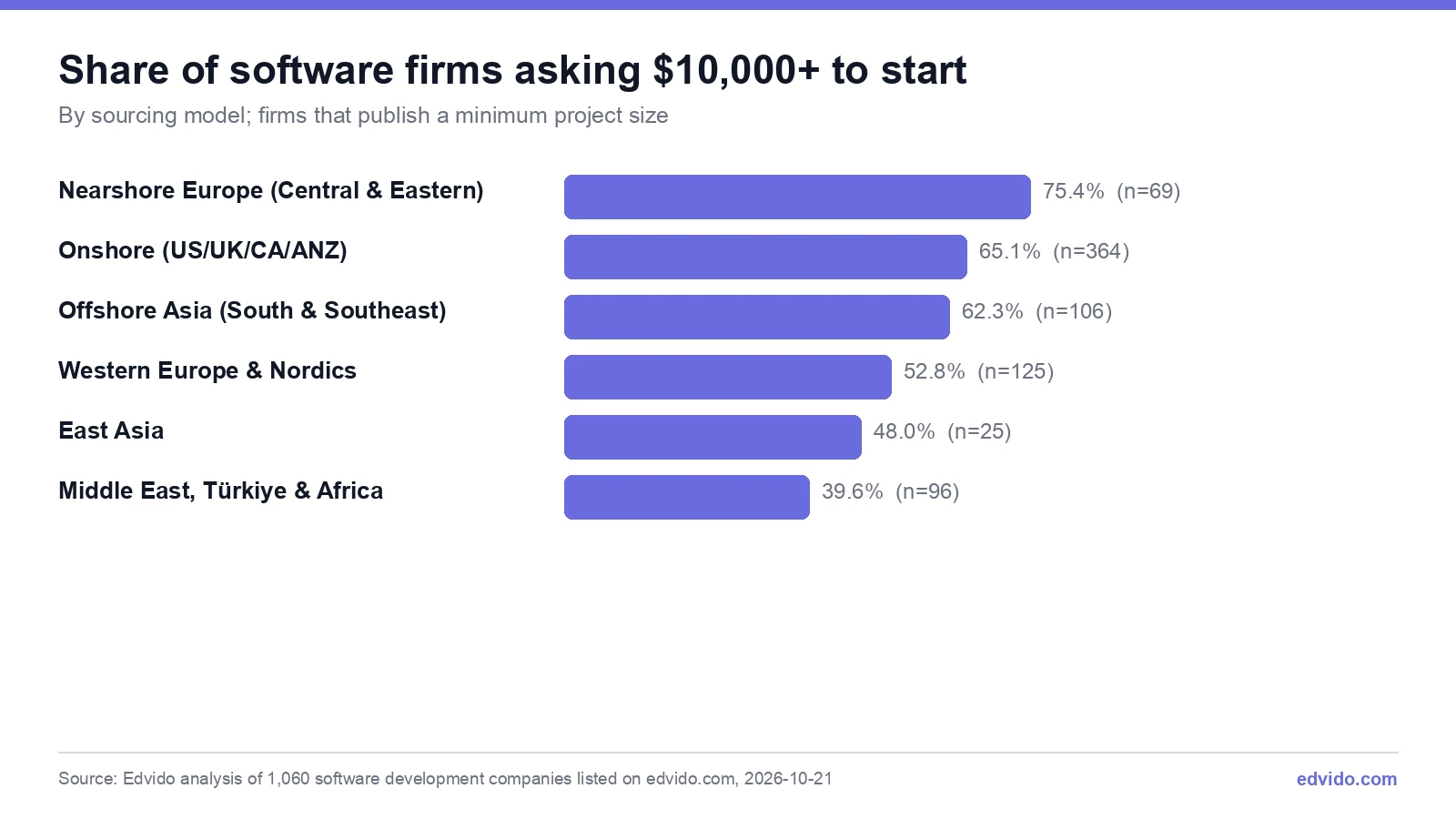
The result runs against the usual advice. Central and Eastern Europe, the standard nearshore choice for European buyers, has the highest share of $10,000+ minimums of any group (75.4%) and almost no firms at the $1,000 floor (2.9%). South and Southeast Asia sits close to the onshore markets on entry point (62.3% vs 65.1% at $10,000+). The groups where small projects are easiest to place are the Middle East, Türkiye and Africa (29.2% at $1,000 or less) and East Asia (24.0%, from only 25 firms).
Some city examples, each with at least 12 firms that publish a minimum: in Belgrade 64.3% of firms start at $10,000+ (n=14), in Bangkok 69.2% (n=13) and in Istanbul 38.5% (n=13). City samples are small, so treat them as indicators.
Team size: offshore firms are bigger
Software is a larger-team business than marketing. 37.1% of software firms have 50 or more people, against 19.5% across all nine agency types we track. Only 21.7% are 2-9 person teams (38.3% across all types).
| Sourcing model | 2-9 people | 50+ people |
|---|---|---|
| East Asia | 11.3% | 52.8% |
| Offshore Asia (South & Southeast) | 11.8% | 49.6% |
| Nearshore Europe (Central & Eastern) | 8.2% | 41.1% |
| Onshore (US, UK & Ireland, Canada, Australia/NZ) | 24.5% | 35.0% |
| Western Europe & Nordics | 26.6% | 34.7% |
| Middle East, Türkiye & Africa | 25.6% | 28.0% |
Team size and minimums move together. 41.8% of 2-9 person firms start at $10,000+, compared with 59.3% of 10-49 person firms, 68.3% of 50-249 person firms, 74.6% of 250-999 person firms and 88.0% of 1,000-9,999 person firms.
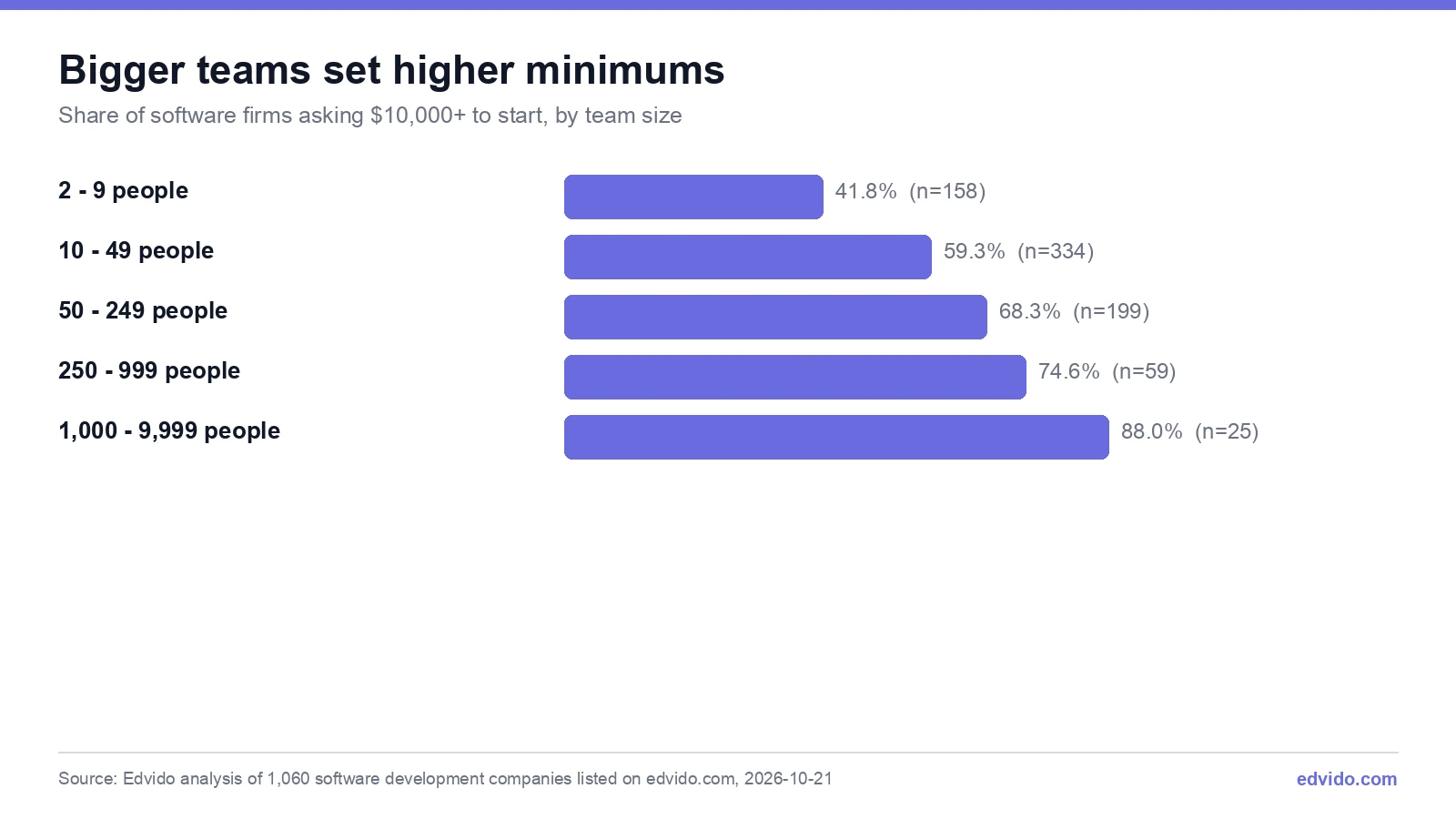
This is the main reason offshore and nearshore floors are high: those markets have fewer small studios. If your project is small, a 2-9 person firm is your most realistic partner. They make up about a quarter of firms in Western Europe and the Nordics (26.6%), the Middle East, Türkiye and Africa (25.6%) and the onshore markets (24.5%), but only 8.2% in Central and Eastern Europe.
What software firms build besides custom software
91.5% of the firms list custom software development. The most common additional services are mobile app development (34.8%), web development (32.7%), e-commerce development (10.7%), UX/UI design (9.7%), cloud consulting (7.5%), IT managed services (7.5%) and artificial intelligence (7.4%). The industries they most often name as clients are financial services (20.8%), business services (20.5%), information technology (19.8%), medical (14.5%), consumer products (12.3%) and e-commerce (11.9%).
The mix differs by region in ways that matter for outsourcing:
- Mobile: 47.9% of South and Southeast Asian firms build mobile apps, the highest of any group. Our app development pricing report covers mobile-only firms.
- Staff augmentation and UX: Central and Eastern European firms list staff augmentation (13.7%) and UX/UI design (16.4%) more than any other group, which fits the "extend my team" use of nearshore.
- E-commerce: 22.1% of firms in the Middle East, Türkiye and Africa group build e-commerce, double the overall rate.
- AI and cloud: East Asian firms list artificial intelligence (11.3%) and cloud consulting (17.0%) most often. If AI is the core of your project, our guide to AI agencies covers what to ask them.
What is settled, what is uncertain
- Software firms set higher entry points than any other agency type we track (median $10,000).
- Larger firms set higher minimums, in every size band we measured.
- Central and Eastern European firms rarely take projects of $1,000 or less (2.9%).
- Hourly rates: we did not measure them, so this data cannot say which region is cheaper per hour.
- East Asia: only 25 firms publish a minimum, so its figures can move with a few firms.
- Whether listed firms represent each market: listings over-represent firms active on international directories.
In practice: how to outsource software development
- Write the brief before choosing a region. Scope, platforms (web, iOS, Android), integrations, deadline and budget range. A clear brief is what makes quotes comparable.
- Filter by minimum project size first. If your budget is under $10,000, you are choosing from about 40% of the market. Start with firms whose published minimum fits.
- Pick the sourcing model for the working relationship, not only the price. Daily collaboration favours onshore or nearshore time zones; a well-specified fixed-scope project travels further.
- Match team size to the job. A single app or MVP fits a 2-49 person firm. Several products in parallel, compliance work or 24/7 support needs a bigger team, and its higher floor.
- Ask for comparable proposals. Same brief, same deliverables, same assumptions about testing, hosting and maintenance. Then compare timelines and who will actually work on your project.
Edvido is a digital smart platform designed to connect businesses with service providers in digital marketing, advertising and software. Send your brief, get matched right away, completely free, and compare proposals from software companies that fit your budget.
Get a Free OfferMethodology
- Source: the company listings shown on Edvido's global software company pages (edvido.com), collected through Edvido's public listing API on 21 October 2026. Minimum project sizes, team sizes, services and client industries are the values firms published on public B2B directory profiles (such as Clutch and Sortlist) that appear on those listings. Edvido did not survey firms for this article.
- Sample: 1,060 unique software development companies across 92 locations (cities, plus a few country-level listings), deduplicated by website. 785 of them (74.1%) publish a minimum project size; the rest are excluded from budget figures.
- Sourcing models: locations were grouped into the regions used in our pricing reports, then into six sourcing models. "Onshore" groups the US, UK and Ireland, Canada and Australia/New Zealand because they are the largest buyer markets in our data; for a buyer elsewhere, "onshore" is their own country.
- Buckets: directories publish minimums in fixed bands ($1,000+, $5,000+, $10,000+, $25,000+ and up), so medians fall on a band.
- Limits: a minimum project size is an entry threshold, not an hourly rate or a quote. Work mode and ratings were too sparse in the source data to report.
Browse the firms behind these numbers in the software companies directory, put two or three side by side with Compare Agencies, or read how we order our lists on the methodology page.
Frequently Asked Questions
What is software development outsourcing?
It is hiring an outside company to design, build or maintain software instead of doing it in-house. The partner can be in your country (onshore), a nearby country (nearshore) or far away (offshore), and can work on a fixed project, as a dedicated team or by adding developers to your team.
How much does it cost to outsource software development in 2026?
In Edvido's October 2026 analysis of 1,060 software companies, the median minimum project size is $10,000. 14.8% of firms accept projects of $1,000 or less, 60.0% start at $10,000 or more and 28.2% at $25,000 or more. Final cost depends on scope; country-level figures are in our software development pricing report.
Is nearshore cheaper than onshore?
Not at the entry point. In our data 75.4% of Central and Eastern European firms start at $10,000 or more, compared with 65.1% of firms in the US, UK and Ireland, Canada and Australia/New Zealand. Hourly rates can still differ; we did not measure them.
Where can I outsource a small software project?
Firms accepting projects of $1,000 or less are most common in the Middle East, Türkiye and Africa group (29.2%) and East Asia (24.0%), and least common in Central and Eastern Europe (2.9%). Small teams of 2-9 people are the most likely to take small projects.
Do bigger software companies charge more?
They set higher minimums. 41.8% of 2-9 person firms start at $10,000 or more, compared with 68.3% of 50-249 person firms and 88.0% of 1,000-9,999 person firms.
What else do software development companies offer?
Besides custom software, 34.8% build mobile apps, 32.7% do web development, 10.7% build e-commerce and 7.4% list artificial intelligence. Staff augmentation is offered by 5.6% overall and 13.7% in Central and Eastern Europe.